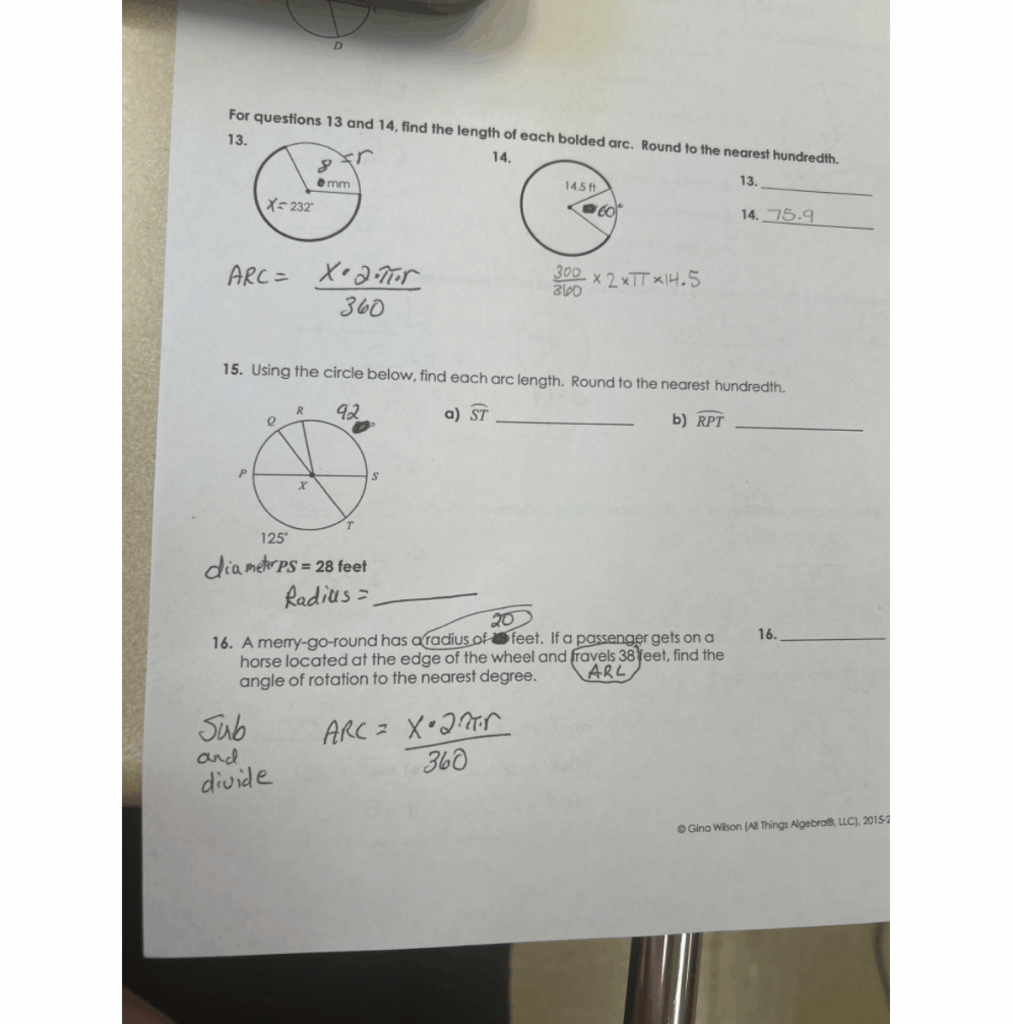
For questions 13 and 14, find the length of each bolded arc. Round to the nearest hundredth. 13.
14.
- ]]
- 75.9 15. Using the circle below, find each arc length. Round to the nearest hundredth. a)
b)
20 16. A merry-go-round has a radius of feet. If a passenger gets on a 16. horse located at the edge of the wheel and ravels 38 feet, find the angle of rotation to the nearest degree. ARL Sub and divide
- 75.9 15. Using the circle below, find each arc length. Round to the nearest hundredth. a)
(5) Gina Wilson (All Things Avgebrab, LLC), 2015-2
The Correct Answer and Explanation is:
Of course. Here are the correct answers and a detailed, textbook-style explanation for each problem on the worksheet.
Conceptual Foundation: Arc Length and Central Angles
The problems on this worksheet involve calculating the length of an arc of a circle. An arc is a portion of the circumference of a circle. Its length is directly proportional to the measure of its corresponding central angle—the angle whose vertex is the center of the circle and whose sides are radii intersecting the circle at the arc’s endpoints.
The formula to find the length of an arc is derived from the formula for the circumference of a full circle (C = 2πr). The arc length is a fraction of the total circumference, determined by the fraction of the full 360° that the central angle represents.
The governing formula is:
Arc Length = (θ / 360°) × 2πr
Where:
- θ (theta) is the measure of the central angle in degrees.
- r is the radius of the circle.
Problem Solutions
Question 13
- Given: Central angle (θ) = 232°, Radius (r) = 8 mm.
- Objective: Find the length of the bolded arc.
The bolded arc corresponds directly to the given central angle. Applying the arc length formula:
Arc Length = (232° / 360°) × 2π(8)
Arc Length = (232 / 360) × 16π
Arc Length ≈ 0.6444 × 16π
Arc Length ≈ 10.3111π
Arc Length ≈ 32.394… mm
Rounding to the nearest hundredth, the length of the arc is 32.39 mm.
Question 14
- Given: Radius (r) = 14.5 ft. The un-bolded arc has a central angle of 60°.
- Objective: Find the length of the bolded (major) arc.
First, determine the central angle of the bolded arc. A full circle is 360°.
θ = 360° – 60° = 300°
Now, apply the arc length formula with this angle:
Arc Length = (300° / 360°) × 2π(14.5)
Arc Length = (5 / 6) × 29π
Arc Length = (145π / 6)
Arc Length ≈ 75.9218… ft
Rounding to the nearest hundredth, the length of the arc is 75.92 ft.
Question 15
- Given: Diameter PS = 28 feet, which means the radius (r) is 14 feet. The measure of arc QR is 92°, and the measure of arc PT is 125°.
- Objective: Find the lengths of arc ST and arc RPT.
a) Find the length of arc ST.
Since PS is a diameter, the arc from P through T to S (arc PTS) is a semicircle, which measures 180°.
Measure of arc ST = Measure of arc PTS – Measure of arc PT
Measure of arc ST = 180° – 125° = 55°
Now, calculate the length of arc ST using its angle measure:
Arc Length (ST) = (55° / 360°) × 2π(14)
Arc Length (ST) = (55 / 360) × 28π
Arc Length (ST) ≈ 0.1527 × 28π
Arc Length (ST) ≈ 13.439… ft
Rounding to the nearest hundredth, the length of arc ST is 13.44 ft.
b) Find the length of arc RPT.
The arc RPT is the arc that travels from point R, through point P, to point T. Its measure is the sum of m(arc RP) + m(arc PT). We know m(arc PT) = 125°, but m(arc RP) is unknown. For the given information to be consistent, the segment RT must also be a diameter. This would make arc RPT a semicircle measuring 180°. (This is consistent because it would imply m(arc TQR) is also a semicircle, and m(arc TQ) + m(arc QR) = 88° + 92° = 180°).
Therefore, the measure of arc RPT is 180°. Its length is half the circle’s circumference.
Arc Length (RPT) = (180° / 360°) × 2π(14)
Arc Length (RPT) = (1/2) × 28π
Arc Length (RPT) = 14π
Arc Length (RPT) ≈ 43.982… ft
Rounding to the nearest hundredth, the length of arc RPT is 43.98 ft.
Question 16
- Given: Radius (r) = 20 feet, Arc Length = 38 feet.
- Objective: Find the angle of rotation (the central angle θ) to the nearest degree.
This problem requires rearranging the arc length formula to solve for the angle, θ.
Arc Length = (θ / 360°) × 2πr
38 = (θ / 360) × 2π(20)
38 = (θ / 360) × 40π
To isolate θ, multiply both sides by 360 and divide by 40π:
38 × 360 = θ × 40π
13680 = θ × 40π
θ = 13680 / (40π)
θ = 342 / π
θ ≈ 108.86…°
Rounding to the nearest degree, the angle of rotation is 109°.