How many free variables does each augmented matrix have? One % s] Three None Two
The Correct Answer and Explanation is:
Here are the correct answers and a detailed explanation for each augmented matrix.
Correct Answers:
- a. Two
- b. Two
- c. One
- d. None
Explanation
In linear algebra, an augmented matrix represents a system of linear equations. The variables in this system can be classified as either basic variables or free variables. To determine the number of free variables, we first need to identify the pivot positions in the matrix, which is assumed to be in row echelon form.
- A pivot position in a matrix is the location of a leading ‘1’ in a non-zero row after the matrix has been brought to reduced row echelon form. In a matrix already in echelon form, it is the first non-zero entry in each non-zero row.
- A pivot column is a column that contains a pivot position.
- A basic variable is a variable that corresponds to a pivot column.
- A free variable is any variable that does not correspond to a pivot column. The number of free variables is therefore the total number of variables (columns in the coefficient matrix) minus the number of basic variables (pivot columns). Free variables can be assigned any value, and the values of the basic variables will depend on them.
Let’s analyze each matrix:
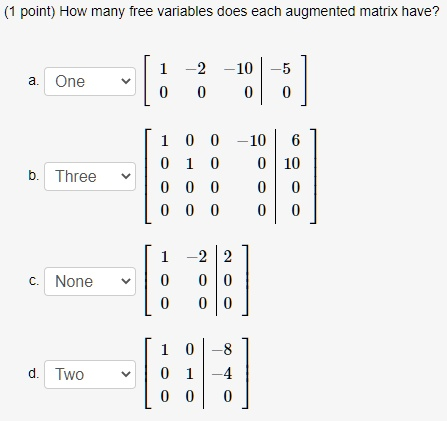
a. The augmented matrix is: [ 1 -2 -10 | -5 ]
[ 0 0 0 | 0 ]
- Identify Variables: The coefficient matrix (the part before the vertical line) has 3 columns. Let’s call the variables x₁, x₂, and x₃.
- Identify Pivot Columns: The first non-zero entry in the first row is in the first column. The second row is all zeros, so it has no pivot. Therefore, only the first column is a pivot column.
- Count Free Variables: Since column 1 is a pivot column, x₁ is a basic variable. Columns 2 and 3 do not contain a pivot, so x₂ and x₃ are free variables.
- Number of free variables: Two
b. The augmented matrix is: [ 1 0 0 -10 | 6 ]
[ 0 1 0 0 | 10 ]
[ 0 0 0 0 | 0 ]
[ 0 0 0 0 | 0 ]
- Identify Variables: The coefficient matrix has 4 columns (x₁, x₂, x₃, x₄).
- Identify Pivot Columns: The pivot in the first row is in the first column. The pivot in the second row is in the second column. The other rows are zero rows.
- Count Free Variables: Columns 1 and 2 are pivot columns, so x₁ and x₂ are basic variables. Columns 3 and 4 do not contain pivots, so x₃ and x₄ are free variables.
- Number of free variables: Two
c. The augmented matrix is: [ 1 -2 | 2 ]
[ 0 0 | 0 ]
[ 0 0 | 0 ]
- Identify Variables: The coefficient matrix has 2 columns (x₁, x₂).
- Identify Pivot Columns: The pivot in the first row is in the first column. The other rows are zero rows.
- Count Free Variables: Column 1 is a pivot column, so x₁ is a basic variable. Column 2 does not contain a pivot, so x₂ is a free variable.
- Number of free variables: One
d. The augmented matrix is: [ 1 0 | -8 ]
[ 0 1 | -4 ]
[ 0 0 | 0 ]
- Identify Variables: The coefficient matrix has 2 columns (x₁, x₂).
- Identify Pivot Columns: The pivot in the first row is in the first column. The pivot in the second row is in the second column.
- Count Free Variables: Both column 1 and column 2 are pivot columns. Thus, both x₁ and x₂ are basic variables. There are no columns left without a pivot. This system has a unique solution (x₁ = -8, x₂ = -4).
- Number of free variables: None (or zero)
