Get My Reward! You can get the treasures of the chest if you will be able to correctly rewrite all expressions without using zero or negative integral exponent.
Questions: 1. Did you get the treasures? How does it feel? 2. How did you simplify the given expressions? 3. What are the concepts/processes to remember in simplifying expressions without zero and negative integral exponents?
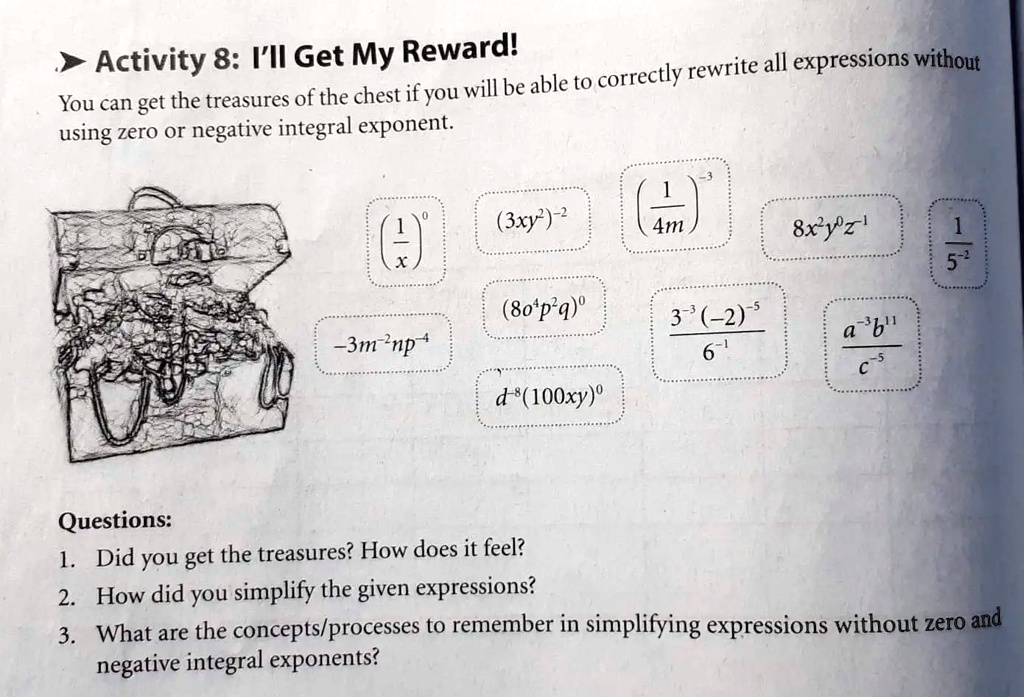
The Correct Answer and Explanation is:
Correct Answers
Here are the simplified forms of all expressions, rewritten without zero or negative exponents:
- (1/x)⁰ = 1
- (3xy²)⁻² = 1 / (9x²y⁴)
- (1 / 4m)⁻³ = 64m³
- 8x²y⁰z⁻¹ = 8x² / z
- 1 / 5⁻² = 25
- -3m⁻²np⁻⁴ = -3n / (m²p⁴)
- (80⁴p²q)⁰ = 1
- (3⁻³(-2)⁻⁵) / 6⁻¹ = -1 / 144
- d⁻⁸(100xy)⁰ = 1 / d⁸
- (a⁻³b¹¹) / c⁻⁵ = (b¹¹c⁵) / a³
Explanation
Yes, the treasures of the chest were obtained by correctly applying the laws of exponents to each expression. It is a rewarding feeling to transform complex-looking expressions into their simplest forms, demonstrating a clear understanding of fundamental mathematical concepts.
The given expressions were simplified by following a systematic process based on the rules for integer exponents. The key was to identify any terms with zero or negative exponents and rewrite them.
Key Concepts and Processes (Answering Questions 2 & 3):
To simplify expressions without zero and negative exponents, three main concepts are crucial:
- The Zero Exponent Rule: Any non-zero base raised to the power of zero is always equal to 1. For example, in the expression 8x²y⁰z⁻¹, the term y⁰ simplifies to 1. Similarly, the entire quantities (1/x)⁰ and (80⁴p²q)⁰ become 1.
- The Negative Exponent Rule: A base raised to a negative exponent is equivalent to its reciprocal with a positive exponent. To handle a term like a⁻ⁿ, it is rewritten as 1/aⁿ. For instance, in d⁻⁸(100xy)⁰, the d⁻⁸ becomes 1/d⁸. In the expression -3m⁻²np⁻⁴, the terms m⁻² and p⁻⁴ were moved to the denominator as m² and p⁴, resulting in -3n / (m²p⁴).
- The Reciprocal Rule for Negative Exponents: Conversely, if a term with a negative exponent is in the denominator, it moves to the numerator to become positive. The expression 1/a⁻ⁿ simplifies to aⁿ. This was used for 1/5⁻², which became 5² or 25, and for c⁻⁵ in the denominator of (a⁻³b¹¹) / c⁻⁵, which moved to the numerator as c⁵.
By applying these rules, along with other properties like the power of a product (ab)ⁿ = aⁿbⁿ, each expression was methodically rewritten into a final, simplified form containing only positive exponents