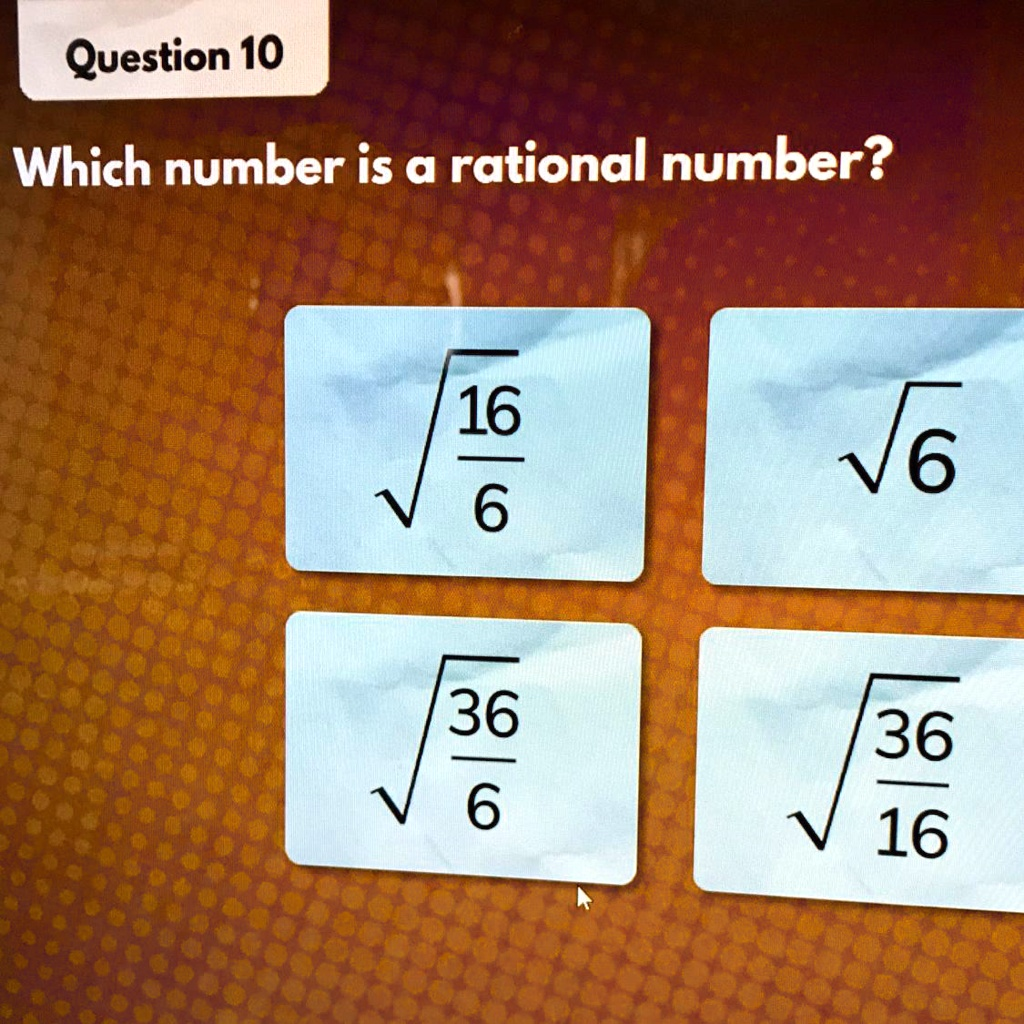
Which number is a rational number?
The Correct Answer and Explanation is:
Correct Answer: √(36/16)
Explanation:
A rational number is any number that can be expressed as a fraction or ratio of two integers, in the form p/q, where p (the numerator) and q (the denominator) are both integers and q is not zero. The decimal representation of a rational number either terminates (like 0.25) or repeats in a predictable pattern (like 0.333…). Numbers that cannot be expressed this way are called irrational numbers; their decimal representations go on forever without repeating.
To determine which of the given options is a rational number, each expression must be evaluated.
- √(16/6): This fraction can be simplified to 8/3. The expression becomes √(8/3). The square root of a fraction is rational only if both the numerator and the denominator are perfect squares. Since neither 8 nor 3 are perfect squares, √(8/3) is an irrational number.
- √6: The number 6 is not a perfect square (2²=4, 3²=9). The square root of any integer that is not a perfect square is always an irrational number. Therefore, √6 is irrational.
- √(36/6): This expression simplifies to √6. As established in the previous point, √6 is an irrational number.
- √(36/16): This expression can be evaluated by taking the square root of the numerator and the denominator separately, as both are perfect squares. The square root of 36 is 6, and the square root of 16 is 4. So, the expression simplifies to the fraction 6/4. This fraction can be further reduced to 3/2. Since 3/2 is a ratio of two integers (3 and 2), it fits the definition of a rational number. As a decimal, it is 1.5, which is a terminating decimal.
Therefore, √(36/16) is the only rational number among the choices.thumb_upthumb_down