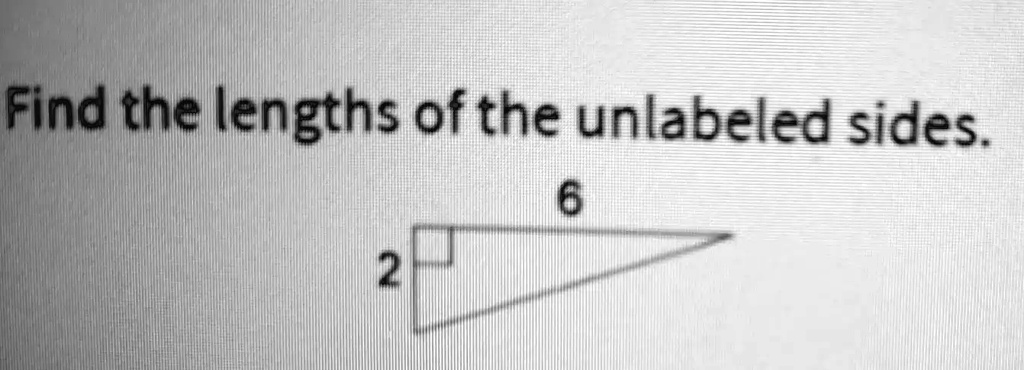
Find the lengths of the unlabeled sides.
The Correct Answer and Explanation is:
The right triangle has a hypotenuse of 6 and one labeled side of 2. To determine the missing side length, the Pythagorean theorem is applied:
c2=a2+b2c^2 = a^2 + b^2
Substituting the known values:
62=22+b26^2 = 2^2 + b^2
Calculating the squares:
36=4+b236 = 4 + b^2
Subtracting 4 from both sides:
32=b232 = b^2
Taking the square root:
b=32=42b = \sqrt{32} = 4\sqrt{2}
Thus, the missing side length is 424\sqrt{2}.
Explanation
The Pythagorean theorem states that the sum of the squares of the two shorter sides of a right triangle equals the square of the hypotenuse. This theorem is fundamental in geometry and allows for the determination of unknown side lengths when given two measurements.
For this particular problem, the hypotenuse is labeled as 6, and one leg is labeled as 2. The unknown side length is found by rearranging the theorem to solve for the missing term. The square of the hypotenuse (36) is set equal to the sum of the squares of the other two sides. After calculating the square of the known side (4), the equation simplifies by subtracting 4 from both sides, leaving 32. Taking the square root provides the precise value of the missing side, which simplifies further into 424\sqrt{2}, ensuring an exact and simplified result.
Understanding the relationships within right triangles is crucial in mathematical problem-solving, physics applications, and engineering computations. Many real-world scenarios, from bridge constructions to navigation systems, depend on such calculations. Mastering these fundamental principles strengthens spatial reasoning, enhances problem-solving skills, and builds a strong foundation for advanced mathematics and applied sciences.