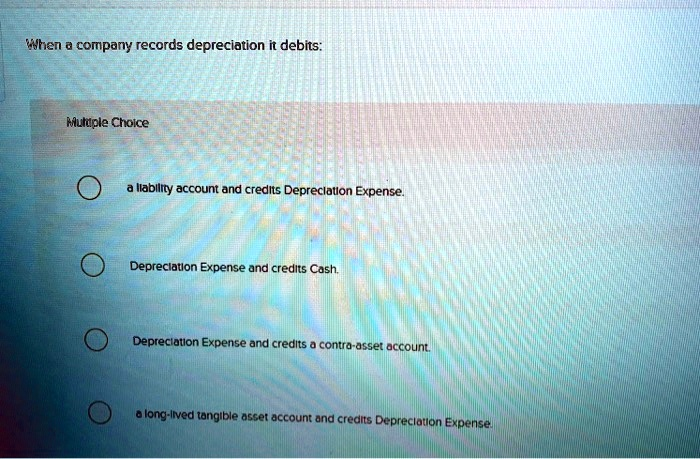
When a company records depreciation it debits: Multiple Choice a liability account and credits Depreciation Expense. Depreciation Expense and credits Cash. Depreciation Expense and credits a contra-asset account. a long-lived tangible asset account and credits Depreciation Expense.
When a company records depreciation it debits: Multiple Choice a liability account and credits Depreciation Expense. Depreciation Expense and credits Cash. Depreciation Expense and credits a contra-asset account. a long-lived tangible asset account and credits Depreciation Expense.
The Correct Answer and Explanation is:
Correct Answer:
Depreciation Expense and credits a contra-asset account.
Explanation:
When a company records depreciation, it is recognizing the reduction in value of its fixed assets over time due to wear and tear or obsolescence. This process is essential for accurately matching expenses with revenues in the periods in which the assets are used.
In accounting terms, depreciation is not recorded by directly reducing the asset account. Instead, the company debits Depreciation Expense, which increases the total expenses reported on the income statement. This action reflects the cost of using the asset during the current accounting period.
At the same time, the company credits a contra-asset account called Accumulated Depreciation. This account is used to track the total depreciation taken on an asset over time. It is paired with the original asset account on the balance sheet, and it reduces the book value of the asset without altering the historical cost recorded in the asset account.
This method ensures transparency by keeping the original cost of the asset visible, while also showing how much of that cost has been allocated to depreciation over time.
The other options are incorrect:
- Debiting a liability and crediting depreciation is not appropriate because depreciation is not a liability.
- Crediting cash is incorrect because depreciation is a non-cash expense; no cash leaves the business when it is recorded.
- Crediting the asset account directly is not standard practice because it would remove the original cost from the books, which is not advisable for long-term asset tracking.
This proper method supports both accurate financial reporting and compliance with generally accepted accounting principles.