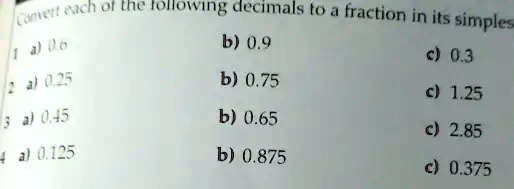
Convert each of the following decimals to a fraction in its simplest 1 a) 0.6 b) 0.9 c) 0.3 2 a) 0.25 b) 0.75 c) 1.25 3 a) 0.45 b) 0.65 c) 2.85 4 a) 0.125 b) 0.875 c) 0.375
The Correct Answer and Explanation is:
Here are the correct answers for the given decimal-to-fraction conversions in simplest form:
- a) 0.6 = 3/5 b) 0.9 = 9/10 c) 0.3 = 3/10
- a) 0.25 = 1/4 b) 0.75 = 3/4 c) 1.25 = 5/4
- a) 0.45 = 9/20 b) 0.65 = 13/20 c) 2.85 = 57/20
- a) 0.125 = 1/8 b) 0.875 = 7/8 c) 0.375 = 3/8
Explanation
Converting decimals to fractions involves expressing the decimal as a fraction with a denominator based on place value. The first step is to write the decimal as a fraction with a denominator that corresponds to the number of decimal places. After that, the fraction must be simplified by dividing both the numerator and denominator by their greatest common divisor.
For example, 0.6 is written as 6/10 because it has one decimal place. The greatest common divisor of 6 and 10 is 2, so dividing both by 2 gives the simplest fraction 3/5. Similarly, 0.25 is written as 25/100, and the greatest common divisor of 25 and 100 is 25, reducing it to 1/4.
When dealing with improper fractions such as 1.25, the decimal is first written as 125/100 because there are two decimal places. Simplifying by dividing the numerator and denominator by their greatest common divisor, 25, results in the simplest fraction 5/4.
Decimals with three decimal places, such as 0.125, are converted to fractions with denominators of 1000. This means 0.125 becomes 125/1000. The greatest common divisor in this case is 125, which simplifies it to 1/8.
Understanding how to convert decimals into fractions is useful for solving algebraic expressions, calculating ratios, and interpreting percentages in everyday applications. Mastering this conversion allows better handling of numerical relationships across mathematics and science.
