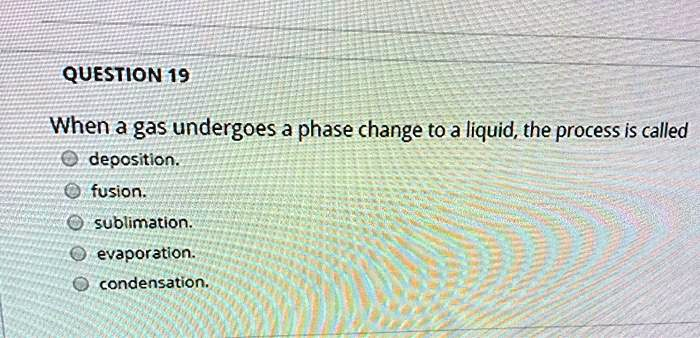
When a gas undergoes a phase change to a liquid, the process is called deposition_ fusion sublimation evaporation: condensation
The Correct Answer and Explanation is:
The correct answer is condensation.
Condensation is the process by which a substance in the gaseous phase transitions into a liquid. This occurs when gas particles lose energy, causing their movement to slow down and allowing intermolecular forces to pull them closer together. As a result, the gas molecules aggregate into a liquid phase. This phenomenon is primarily driven by cooling or a reduction in kinetic energy.
A common example of condensation is seen in the formation of dew. When warm air containing water vapor comes into contact with a cooler surface, such as grass or a car windshield, the water vapor condenses into tiny liquid droplets. This same principle applies to cloud formation. When warm air rises and cools in the atmosphere, water vapor condenses into microscopic liquid droplets that gather to form clouds.
Condensation plays a fundamental role in various natural and industrial processes. It is a key component of the water cycle, as it contributes to the formation of precipitation. Additionally, condensation is widely used in refrigeration systems and distillation, where cooling mechanisms cause vapors to condense into liquids for separation and purification.
It is important to differentiate condensation from other phase transitions. Deposition is when a gas changes directly to a solid. Fusion, also known as melting, is the process by which a solid transitions into a liquid. Sublimation refers to the direct phase change from solid to gas. Evaporation describes the opposite of condensation, where a liquid transforms into a gas.
Understanding condensation allows for better comprehension of thermodynamic principles, phase changes, and applications across fields such as meteorology, chemistry, and engineering.
