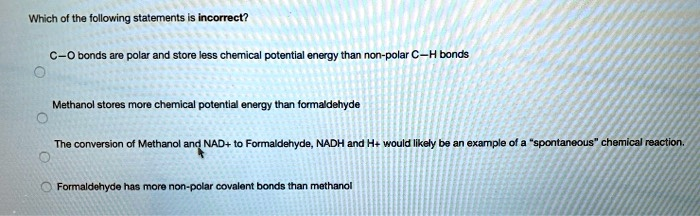
Which of the following statements is incorrect? Bonds are polar and store less chemical potential energy than non-polar C-H bonds. Methanol stores more chemical potential energy than formaldehyde. The conversion of methanol and NAD+ to formaldehyde, NADH, and H- is likely an example of a spontaneous chemical reaction. Formaldehyde has more non-polar covalent bonds than methanal.
The Correct Answer and Explanation is:
The incorrect statement is: Formaldehyde has more non-polar covalent bonds than methanol.
Explanation:
Formaldehyde (CH₂O) and methanol (CH₃OH) are structurally distinct molecules with differing bond characteristics. Formaldehyde contains a carbonyl group (C=O), which is highly polar due to the significant difference in electronegativity between carbon and oxygen. This makes the carbonyl bond strongly polar. Methanol, on the other hand, has a hydroxyl functional group (OH) attached to carbon, which also introduces polarity to the molecule due to the oxygen-hydrogen electronegativity difference.
- Bonds are polar and store less chemical potential energy than non-polar C-H bonds – This statement is correct because non-polar bonds, such as C-H, store more chemical potential energy compared to polar bonds like C=O. Non-polar bonds distribute electron density more evenly, whereas polar bonds involve partial charges that lower the overall potential energy.
- Methanol stores more chemical potential energy than formaldehyde – This statement is correct because methanol has more hydrogen atoms bonded to carbon, which are non-polar. These non-polar bonds retain higher chemical potential energy compared to the strongly polarized carbonyl bond in formaldehyde.
- The conversion of methanol and NAD+ to formaldehyde, NADH, and H⁺ is likely a spontaneous chemical reaction – This statement is correct because the oxidation of methanol to formaldehyde is an energetically favorable reaction. It involves electron transfer that results in the reduction of NAD+ to NADH, a process commonly observed in biological systems.
- Formaldehyde has more non-polar covalent bonds than methanol – This statement is incorrect because formaldehyde primarily consists of a C=O polar bond and two C-H bonds, whereas methanol contains three C-H bonds and one O-H bond. Methanol, therefore, has more non-polar covalent bonds compared to formaldehyde.