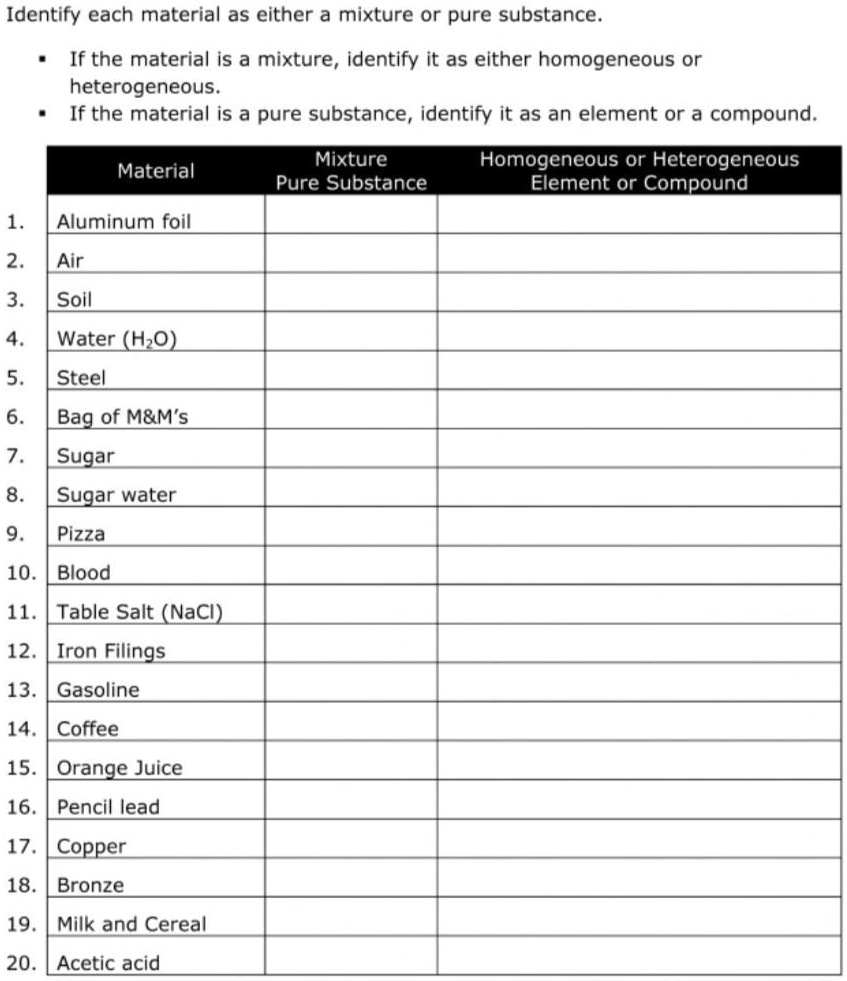
Identify each material as either a mixture or pure substance. • If the material is a mixture, identify it as either homogeneous or heterogeneous. • If the material is a pure substance, identify it as an element or a compound. Material Mixture Pure Substance 1. Aluminum foil 2. Air 3. Soil 4. Water (
) 5. Steel 6. Bag of M&M’s 7. Sugar 8. Sugar water 9. Pizza 10. Blood 11. Table Salt (NaCl) 12. Iron Filings 13. Gasoline 14. Coffee 15. Orange Juice 16. Pencil lead 17. Copper 18. Bronze 19. Milk and Cereal 20. Acetic acid Homogeneous or Heterogeneous Element or Compound
The Correct Answer and Explanation is:
Here is the classification of each material:
| Material | Mixture or Pure Substance | Homogeneous or Heterogeneous / Element or Compound |
|---|---|---|
| Aluminum foil | Pure Substance | Element |
| Air | Mixture | Homogeneous |
| Soil | Mixture | Heterogeneous |
| Water (H₂O) | Pure Substance | Compound |
| Steel | Mixture | Homogeneous |
| Bag of M&M’s | Mixture | Heterogeneous |
| Sugar | Pure Substance | Compound |
| Sugar water | Mixture | Homogeneous |
| Pizza | Mixture | Heterogeneous |
| Blood | Mixture | Heterogeneous |
| Table Salt (NaCl) | Pure Substance | Compound |
| Iron Filings | Pure Substance | Element |
| Gasoline | Mixture | Homogeneous |
| Coffee | Mixture | Homogeneous |
| Orange Juice | Mixture | Homogeneous |
| Pencil lead | Pure Substance | Element (Graphite) |
| Copper | Pure Substance | Element |
| Bronze | Mixture | Homogeneous |
| Milk and Cereal | Mixture | Heterogeneous |
| Acetic acid | Pure Substance | Compound |
Explanation:
Substances can be categorized as either pure substances or mixtures. A pure substance has a fixed composition and distinct chemical properties. Elements are composed of only one type of atom, such as aluminum foil, iron filings, copper, and pencil lead (graphite). Compounds consist of two or more chemically bonded atoms, such as water, table salt, sugar, and acetic acid.
Mixtures consist of multiple substances physically combined but not chemically bonded. They can be homogeneous, meaning they have a uniform composition throughout, or heterogeneous, meaning their composition varies in different portions. Air, steel, sugar water, gasoline, coffee, orange juice, and bronze are homogeneous mixtures because their components are evenly distributed. Soil, a bag of M&M’s, pizza, blood, and milk with cereal are heterogeneous mixtures because their composition varies within the sample.
This classification is fundamental in chemistry and materials science, as it helps determine the properties, applications, and interactions of substances. Homogeneous mixtures are often useful in industrial processes requiring consistent composition, while heterogeneous mixtures are relevant in biological and geological studies where diversity in composition plays a crucial role. Understanding these distinctions enhances analytical skills in chemistry and promotes practical applications in various fields.