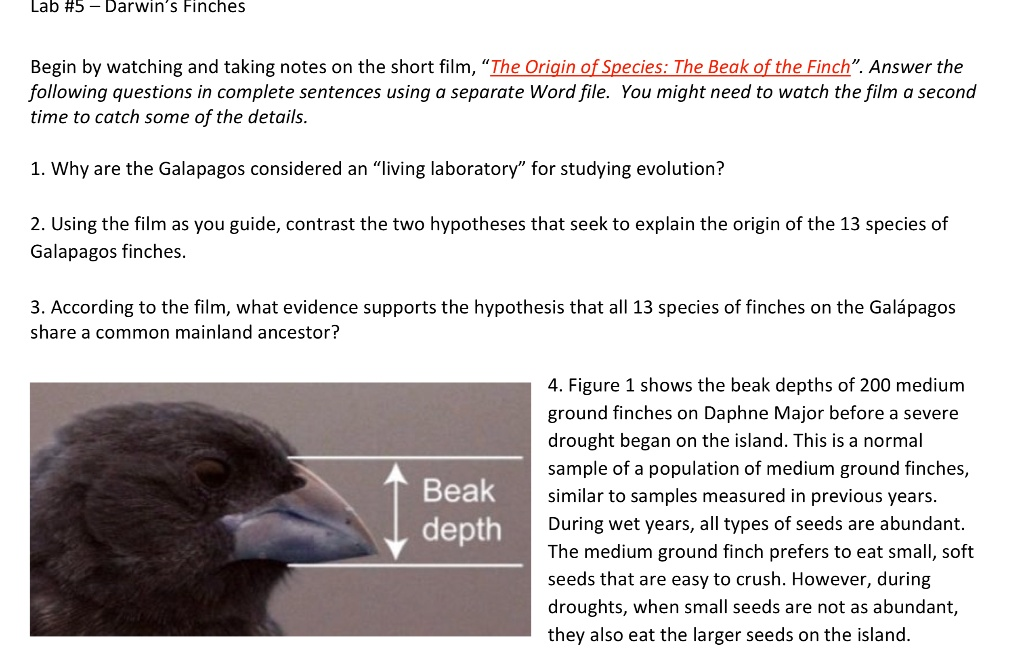
Begin by watching and taking notes on the short film, “The Origin of Species: The Beak of the Finch”. Answer the following questions in complete sentences using a separate Word file. You might need to watch the film a second time to catch some of the details. 1. Why are the Galapagos considered an “living laboratory” for studying evolution? 2. Using the film as you guide, contrast the two hypotheses that seek to explain the origin of the 13 species of Galapagos finches. 3. According to the film, what evidence supports the hypothesis that all 13 species of finches on the Galápagos share a common mainland ancestor? Beak depth 4. Figure 1 shows the beak depths of 200 medium ground finches on Daphne Major before a severe drought began on the island. This is a normal sample of a population of medium ground finches, similar to samples measured in previous years. During wet years, all types of seeds are abundant. The medium ground finch prefers to eat small, soft seeds that are easy to crush. However, during droughts, when small seeds are not as abundant, they also eat the larger seeds on the island.
The Correct Answer and Explanation is:
Here’s a structured response to your lab questions on Darwin’s finches:
1. Why are the Galápagos considered a “living laboratory” for studying evolution? The Galápagos Islands are an ideal location for studying evolution due to their isolated environment, diverse ecosystems, and distinct species that have adapted to specific niches. The archipelago allows scientists to observe natural selection in action, particularly through the finches, whose beak shapes have evolved to match available food sources. The rapid environmental changes on the islands provide real-time evidence of evolutionary adaptation, making them a perfect setting for studying speciation and survival mechanisms.
2. Contrast the two hypotheses that seek to explain the origin of the 13 species of Galápagos finches. The first hypothesis suggests that a single ancestral species arrived from the mainland and diversified into multiple species through adaptive radiation. Over time, natural selection favored different beak shapes suited to various food sources, leading to the emergence of distinct finch species. The second hypothesis proposes that multiple waves of finch migration occurred, each bringing different genetic traits that contributed to species differentiation. Instead of a single lineage diversifying, this idea considers repeated introductions as a mechanism for species evolution.
3. What evidence supports the hypothesis that all 13 species share a common mainland ancestor? The film highlights genetic studies showing that the finches’ DNA has strong similarities, indicating they descended from a shared ancestor. Observational data from the islands reveal how slight variations in beak morphology correspond to ecological niches, a pattern consistent with adaptive radiation. Fossil evidence and molecular analyses further support the theory that these birds evolved from a single migratory species that reached the Galápagos.
4. Beak depth and environmental influences The graph in Figure 1 illustrates the distribution of beak depths in medium ground finches before a drought. In normal conditions, smaller, softer seeds are abundant, favoring finches with shallower beaks. However, when droughts occur and small seeds become scarce, birds with deeper, stronger beaks are better suited to crack harder seeds, improving their survival chances. Natural selection favors these traits, resulting in a gradual shift toward deeper-beaked individuals over successive generations.
This study underscores how environmental pressures drive evolutionary change in observable ways. The Galápagos finches provide concrete proof of Darwin’s principles, showing that adaptation occurs when survival depends on inherited characteristics suited to changing conditions.