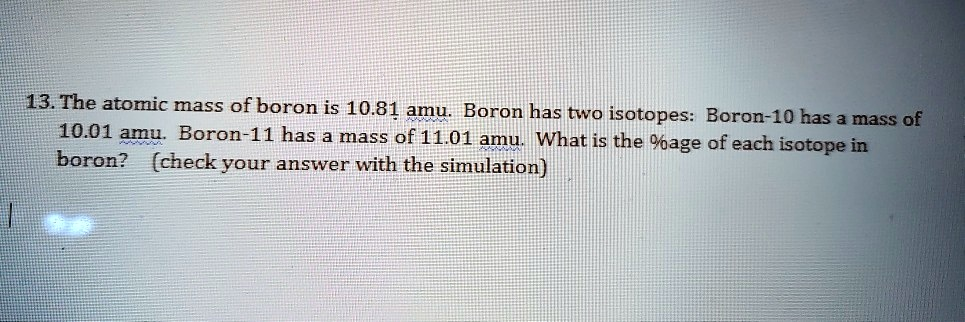
The atomic mass of boron is 10.81 amu. Boron has two isotopes: Boron-10 has a mass of 10.01 amu. Boron-11 has a mass of 11.01 amu. What is the \%age of each isotope in boron? (check your answer with the simulation)
The Correct Answer and Explanation is:
To determine the percentage of each isotope in boron, we use the concept of weighted average atomic mass. The atomic mass of boron is given as 10.81 amu, which results from the contributions of its two isotopes, Boron-10 and Boron-11. The mathematical approach involves setting up an equation based on the given masses and abundances.
Let x represent the fraction of Boron-10, and since the total abundance must sum to 1, the fraction of Boron-11 is 1 – x. The weighted average atomic mass equation is:
10.01x + 11.01(1 – x) = 10.81
Expanding the equation:
10.01x + 11.01 – 11.01x = 10.81
Rearrange the terms:
(10.01 – 11.01)x = 10.81 – 11.01
-1x = -0.20
Solving for x:
x = 0.20
Thus, the fraction of Boron-10 is 20%. Since the fraction of Boron-11 is 1 – x, we get:
1 – 0.20 = 0.80
Therefore, the fraction of Boron-11 is 80%.
Explanation
Boron exists as a mixture of two isotopes, Boron-10 and Boron-11, which contribute to its atomic mass of 10.81 amu. The atomic mass represents a weighted average, reflecting the proportions of each isotope found in nature. To determine the abundance of each isotope, we set up an equation based on their individual masses and the given atomic mass. Since the total abundance must be 100 percent, we express Boron-10’s abundance as x and Boron-11’s abundance as 1 – x. By solving the equation, we find that Boron-10 constitutes 20 percent of boron, while Boron-11 makes up 80 percent. This method is commonly used in chemistry to understand isotopic composition and provides valuable insights into how atomic masses are determined experimentally.