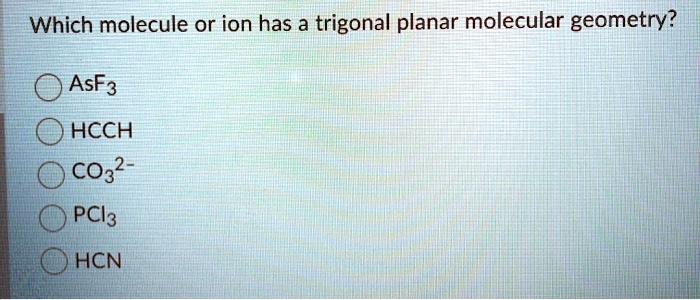
Which molecule or ion has a trigonal planar molecular geometry? AsF3 HCCH CO32 – PCl3 HCN
The Correct Answer and Explanation is:
The molecule or ion that exhibits trigonal planar molecular geometry from the given options is CO32⁻ (carbonate ion).
Trigonal planar geometry occurs when a central atom is bonded to three surrounding atoms with no lone pairs on the central atom. This arrangement allows the atoms to be distributed evenly around the central atom in a flat, triangular shape with bond angles of approximately 120 degrees. The carbonate ion follows this principle due to its electronic structure and resonance characteristics.
The carbonate ion consists of a central carbon atom bonded to three oxygen atoms. Carbon has four valence electrons and forms three equivalent bonds with the oxygens. The presence of resonance stabilizes the ion, meaning that the double bond is delocalized across all three oxygen atoms, creating an average bond order of 1.33 per carbon-oxygen bond. This delocalization results in uniform bond lengths and prevents the ion from adopting an asymmetric shape.
Other molecules in the given list do not exhibit trigonal planar geometry. Arsenic trifluoride has a trigonal pyramidal shape due to a lone pair on arsenic. Acetylene is linear because of its triple-bonded carbon atoms. Phosphorus trichloride also has trigonal pyramidal geometry due to a lone pair on phosphorus. Hydrogen cyanide is linear, as carbon forms a triple bond with nitrogen and a single bond with hydrogen.
Understanding trigonal planar geometry is essential in predicting molecular properties such as polarity, reactivity, and intermolecular interactions. The carbonate ion plays a significant role in biological and geological systems, making its molecular shape important for various chemical applications.