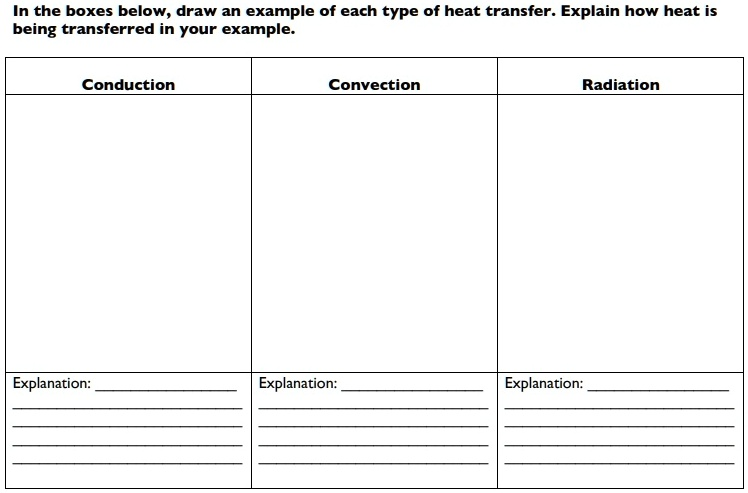
In the boxes below, draw an example of each type of heat transfer. Explain how heat is being transferred in your example. Conduction Convection Explanation: Explanation: Explanation: Radiation
The Correct Answer and Explanation is:
Conduction Drawing: A metal rod with one end placed in a flame and the other end being held by a hand. Explanation: Conduction occurs when heat is transferred through direct contact between particles within a solid material. In this example, heat is transferred from the flame to the metal rod. The particles in the metal gain energy and begin vibrating more intensely. These vibrations spread throughout the rod, transferring thermal energy along its length. Eventually, the heat reaches the other end, making it warm. The efficiency of conduction depends on the material, with metals being excellent conductors due to the presence of free electrons that facilitate energy transfer.
Convection Drawing: A pot of water on a stove with arrows illustrating the circular motion of heated water. Explanation: Convection is the transfer of heat through the movement of fluids, such as liquids or gases. In this example, heat moves from the stove to the water in the pot. The water at the bottom of the pot absorbs thermal energy, becoming less dense and rising. Simultaneously, cooler water descends to replace the rising warm water, establishing a convection current. This circulating flow evenly distributes heat, warming the entire liquid. Convection currents are also responsible for natural phenomena such as ocean currents, wind patterns, and atmospheric circulation.
Radiation Drawing: The sun emitting wavy lines representing heat rays that reach a person standing on the ground. Explanation: Radiation is the transfer of heat through electromagnetic waves without requiring a medium for propagation. In this example, the sun emits infrared radiation, which travels through space and is absorbed by the person’s skin, causing them to feel warm. Unlike conduction and convection, which require material interactions, radiation allows heat to transfer across empty space. This process is essential for heating Earth, enabling life to thrive by providing warmth and energy. Objects with darker surfaces absorb more radiation, while reflective surfaces, such as mirrors or snow, tend to scatter it.
Understanding these heat transfer mechanisms helps in designing efficient thermal management systems, improving insulation materials, and optimizing energy use in engineering and daily life.