lim cotx = 0 (Hint: Graph cotx). Choose the correct answer below and, if necessary, fill in the answer box to complete your choice. This statement is false because the value of lim cot x does exist but is equal to a nonzero value. (Simplify your answer) A: 0 B: This statement is true because cot x = 0 and lim cot x = 0. C: This statement is false because the value of cot x does not exist. D: This statement is false because the value of cot x does not exist.
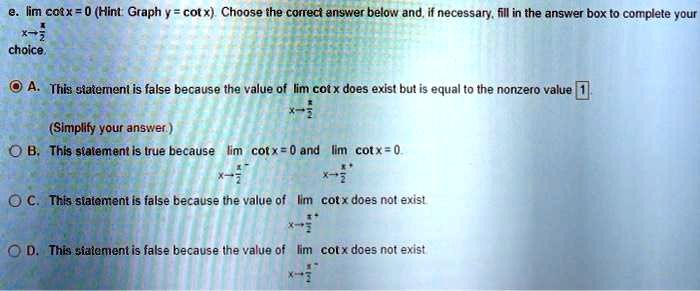
The Correct Answer and Explanation is:
The correct answer is C: This statement is false because the value of lim cot x does not exist.
Explanation:
To analyze the limit of cotangent function as x approaches zero, consider the definition of cotangent:
cotx=cosxsinx\cot x = \frac{\cos x}{\sin x}
Since cosine and sine are fundamental trigonometric functions, their behavior near zero determines the outcome of the limit. As xx approaches zero, cosx\cos x approaches one while sinx\sin x approaches zero. Consequently, cotangent behaves as:
cotx=1sinx\cot x = \frac{1}{\sin x}
This fraction grows arbitrarily large as xx approaches zero from the positive side and arbitrarily small from the negative side. In other words, cotangent tends to positive infinity from the right and negative infinity from the left. Because the left-hand and right-hand limits are not equal, the overall limit does not exist.
Verification Using Graphical Interpretation:
If you graph cotx\cot x, it reveals vertical asymptotes at values where sinx=0\sin x = 0, such as x=0,±π,±2πx = 0, \pm\pi, \pm2\pi. Near x=0x = 0, the function steeply rises and falls, confirming its undefined nature at that point. Unlike functions like sinx\sin x or cosx\cos x, which have finite limits at zero, cotx\cot x diverges infinitely.
Conclusion:
Since cotx\cot x does not settle to any finite number near x=0x = 0, the proposed statement is false. The most accurate justification is that the limit does not exist, making option C the correct choice.
