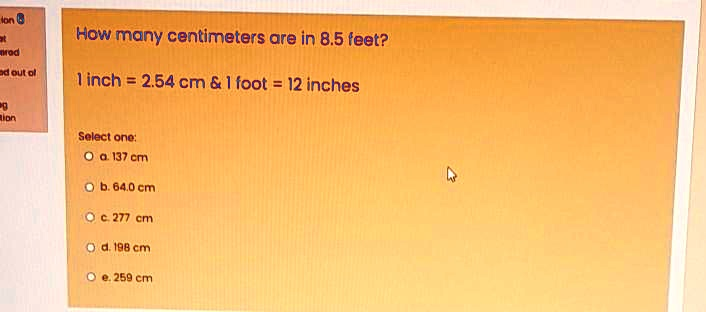
How many centimeters are in 8.5 feet? Mod Module 0 Inch = 2.54 cm & 1 foot = 12 inches Select one: 137 cm 64.0 cm 277 cm 198 cm 259 cm
The Correct Answer and Explanation is:
To determine how many centimeters are in 8.5 feet, we must first convert feet to inches and then convert inches to centimeters using the provided conversion factors.
Step 1: Convert feet to inches
Since one foot contains twelve inches, we multiply: 8.5 feet × 12 inches per foot = 102 inches
Step 2: Convert inches to centimeters
Each inch is equivalent to 2.54 centimeters, so multiplying by this factor gives: 102 inches × 2.54 centimeters per inch = 259.08 centimeters
Correct Answer: 259 cm
Explanation
Converting between different units is a fundamental skill in measurement and mathematics. This problem involves two consecutive conversions, first from feet to inches and then from inches to centimeters. Understanding how each conversion factor works is crucial.
Feet measure length in a larger unit compared to inches. Since there are twelve inches in one foot, multiplying by twelve gives the total number of inches in the given length. This intermediate value helps transition to the next unit.
Inches measure smaller lengths, making them more precise. To convert inches into centimeters, the conversion factor of 2.54 provides a direct relationship between the two units. Multiplying the total inches by this factor results in the final length measurement in centimeters.
Using unit conversions ensures consistency across different measurement systems. In scientific applications, precise measurements are crucial for calculations involving physics, engineering, and various technical fields.
This problem highlights how dimensional analysis applies to real-world contexts. Whether in construction, engineering, or everyday measurements, converting between imperial and metric systems allows for accurate and standardized communication of distances.
Selecting the correct answer, 259 cm, requires careful attention to detail when applying conversion factors. This method ensures that numerical values remain accurate and applicable in practical situations. Understanding these principles strengthens problem-solving skills in mathematics and science.