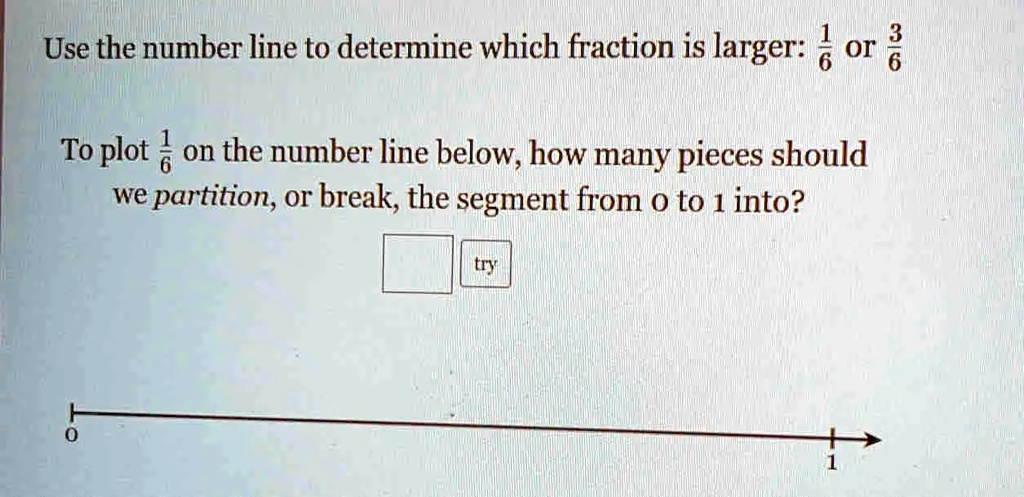
Use the number line to determine which fraction is larger: \frac{1}{6} or \frac{3}{6} To plot \frac{1}{6} on the number line below, how many pieces should we partition, or break, the segment from 0 to 1 into?
The Correct Answer and Explanation is:
To correctly plot 16\frac{1}{6} on the number line, the segment from 0 to 1 should be partitioned into six equal pieces. This is because the denominator of the fraction represents the total number of equal parts into which the whole is divided. The fraction 16\frac{1}{6} indicates that one of these six sections corresponds to the position of the fraction on the number line.
Comparing 16\frac{1}{6} and 36\frac{3}{6}, we examine their numerators. Since both fractions have the same denominator, the fraction with the larger numerator represents the greater value. Here, 36\frac{3}{6} has a numerator of 3, while 16\frac{1}{6} has a numerator of 1. Because 3 is greater than 1, 36\frac{3}{6} is the larger fraction.
To visualize this on the number line, divide the segment from 0 to 1 into six equal parts. Each part corresponds to 16\frac{1}{6}. The first partition point from 0 marks 16\frac{1}{6}, the second marks 26\frac{2}{6}, and the third represents 36\frac{3}{6}. Since 36\frac{3}{6} is further to the right, it is the greater fraction.
The number line is an effective tool for comparing fractions, as it visually displays their relative sizes. By evenly distributing the interval from 0 to 1 into segments matching the denominator, fractional values become easily identifiable. This method reinforces the importance of numerators and denominators when determining fractional magnitudes. Ultimately, 36\frac{3}{6} is larger than 16\frac{1}{6}, and the number line confirms this by showing their relative positions along the segmented interval.