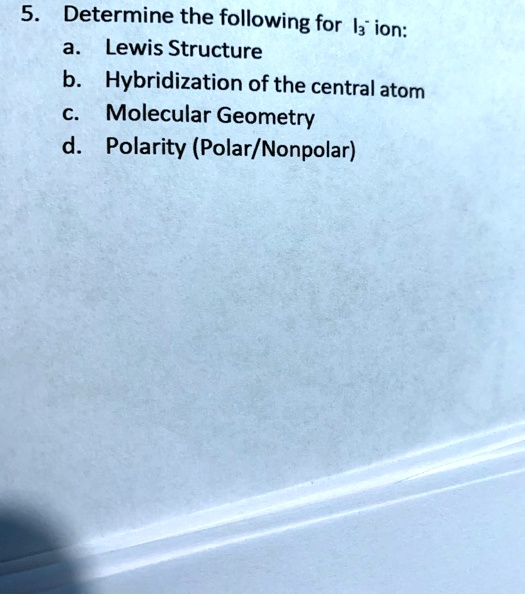
. Determine the following for the I3- ion: a. Lewis Structure b. Hybridization of the central atom c. Molecular Geometry d. Polarity (Polar/Nonpolar)
The Correct Answer and Explanation is:
The I3- ion is an example of a polyatomic ion that exhibits unique bonding and geometry due to the presence of excess electrons.
Lewis Structure
The I3- ion consists of three iodine atoms, where the central iodine is bonded to two terminal iodine atoms. The central atom has three lone pairs of electrons, and the total number of valence electrons in the system is 22. The extra electron contributes to the negative charge. The structure can be represented as:
:I: – I – :I:
Each iodine atom has seven valence electrons, with the central iodine accommodating additional lone pairs.
Hybridization of the Central Atom
The central iodine atom undergoes sp3d hybridization, where one s orbital, three p orbitals, and one d orbital mix to create five hybrid orbitals. Three of these orbitals house lone pairs, while the remaining two form bonding interactions with the terminal iodine atoms.
Molecular Geometry
The molecular geometry of the I3- ion is linear. Although the central iodine carries lone pairs, the arrangement minimizes repulsion, positioning the terminal iodine atoms at 180 degrees from one another.
Polarity
The I3- ion is nonpolar. The symmetrical linear geometry ensures that the dipole moments of the two terminal iodine atoms cancel each other out, preventing an overall dipole moment.
Explanation
The I3- ion serves as an excellent example of electron delocalization and molecular stability. The linear shape arises due to the lone-pair repulsions on the central iodine atom. The sp3d hybridization is crucial in maintaining a stable electronic arrangement, allowing the lone pairs to occupy equatorial positions and reducing steric hindrance. The absence of a net dipole moment leads to the nonpolar nature of the molecule, making it soluble in nonpolar solvents. The I3- ion plays an important role in chemistry, particularly in the triiodide-starch complex, which is used in iodine-based redox reactions and analytical chemistry.
