The Correct Answer and Explanation is:
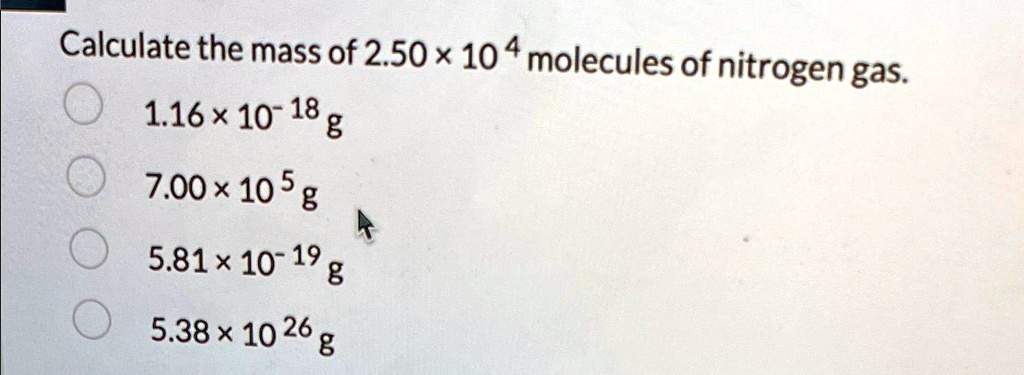
The correct answer to the problem is 1.16 × 10⁻¹⁸ g.
To determine the mass of 2.50 × 10⁴ molecules of nitrogen gas, we use the molar mass of nitrogen gas and Avogadro’s number. The molar mass of nitrogen gas (N₂) is approximately 28.02 g/mol, and Avogadro’s number is 6.022 × 10²³ molecules per mole.
First, we convert the number of molecules into moles using the relationship:
Number of moles=Number of moleculesAvogadro’s number\text{Number of moles} = \frac{\text{Number of molecules}}{\text{Avogadro’s number}}
Number of moles=2.50×1046.022×1023\text{Number of moles} = \frac{2.50 × 10⁴}{6.022 × 10²³}
Number of moles≈4.15×10⁻²⁰ mol\text{Number of moles} ≈ 4.15 × 10⁻²⁰ \text{ mol}
Next, we use the molar mass of nitrogen gas to find the mass:
Mass=Number of moles×Molar mass\text{Mass} = \text{Number of moles} × \text{Molar mass}
Mass=(4.15×10−20)×(28.02)\text{Mass} = (4.15 × 10⁻²⁰) × (28.02)
Mass≈1.16×10⁻¹⁸ g\text{Mass} ≈ 1.16 × 10⁻¹⁸ \text{ g}
Thus, the correct answer is 1.16 × 10⁻¹⁸ g.
This problem demonstrates the relationship between the number of molecules, moles, and mass in chemistry. It highlights the importance of Avogadro’s number in converting between molecular quantities and macroscopic masses. Understanding these conversions is essential for stoichiometry in chemical reactions, where precise amounts of reactants and products must be calculated. The concept also has applications in determining molecular weights, calculating reaction yields, and analyzing the composition of materials at the atomic level. By systematically breaking down the problem, we see how fundamental constants like Avogadro’s number and molar mass enable us to work efficiently with microscopic quantities and apply them to practical chemistry calculations.