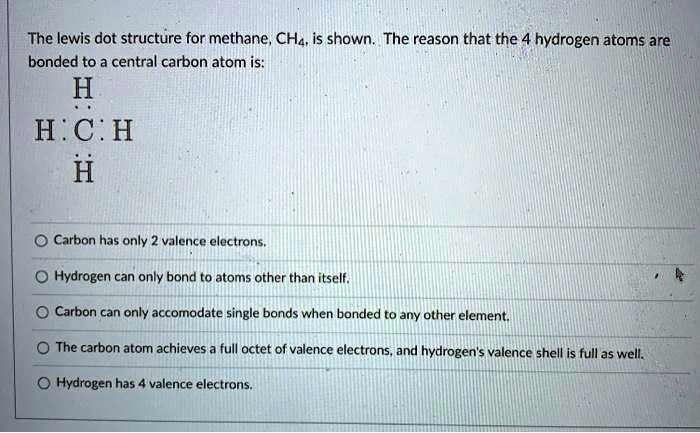
The lewis dot structure for methane, CH
, is shown. The reason that the 4 hydrogen atoms are bonded to a central carbon atom is: H H \text{:} C \text{:} H H Carbon has only 2 valence electrons. Hydrogen can only bond to atoms other than itself. Carbon can only accommodate single bonds when bonded to any other element. The carbon atom achieves a full octet of valence electrons, and hydrogen’s valence shell is full as well. Hydrogen has 4 valence electrons.
The Correct Answer and Explanation is:
Lewis Dot Structure for Methane (CH₄):
      H
       |
   H - C - H
       |
       H
Each line (–) represents a pair of shared electrons (a covalent bond) between carbon and hydrogen.
Explanation:
Methane (CH₄) is a covalent compound composed of one carbon atom and four hydrogen atoms. To understand its structure using the Lewis dot method, we begin by identifying the valence electrons of each atom involved. Carbon is in group 14 of the periodic table and has four valence electrons. Hydrogen is in group 1 and has one valence electron.
In forming methane, the goal is for each atom to reach a stable electron configuration. Carbon needs eight electrons to complete its octet, while hydrogen needs two electrons to fill its only shell. To achieve this, carbon forms four single covalent bonds, one with each hydrogen atom. Each bond consists of two electrons, one from carbon and one from hydrogen, which are shared.
When all four hydrogen atoms form bonds with carbon, carbon ends up with eight electrons in its valence shell (four shared pairs), satisfying the octet rule. Each hydrogen has two electrons in its outer shell due to the shared bond with carbon, fulfilling the duet rule for hydrogen.
The resulting structure shows carbon at the center with hydrogen atoms arranged around it. Although the actual 3D shape of methane is tetrahedral, the Lewis dot structure is drawn in two dimensions and focuses only on electron pairing.
This arrangement is both energetically stable and chemically accurate. All atoms have full outer shells, and there are no unpaired electrons or lone pairs in this molecule. The structure also shows that methane is a nonpolar molecule because the C–H bonds are evenly distributed around the central carbon atom, resulting in a balanced charge distribution.
In summary, the Lewis structure of methane demonstrates how atoms share electrons to achieve stability and form a simple, yet essential, molecular compound.