The Correct Answer and Explanation is:
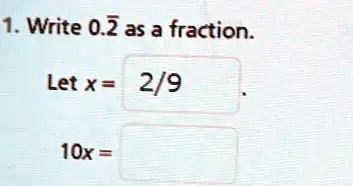
To solve the problem of writing 0.2‾0.\overline{2}0.2 as a fraction, we start by letting x=0.2‾x = 0.\overline{2}x=0.2.
Step 1: Define the repeating decimal
Let
x=0.2222…x = 0.2222\ldotsx=0.2222…
Step 2: Multiply both sides by 10
Since the decimal repeats every one digit, we multiply by 10 to shift the decimal point one place to the right:
10x=2.2222…10x = 2.2222\ldots10x=2.2222…
Step 3: Subtract the original equation from the new equation10x=2.2222…x=0.2222…Subtracting:10x−x=2.2222…−0.2222…9x=210x = 2.2222\ldots \\ x = 0.2222\ldots \\ \text{Subtracting:} \\ 10x – x = 2.2222\ldots – 0.2222\ldots \\ 9x = 210x=2.2222…x=0.2222…Subtracting:10x−x=2.2222…−0.2222…9x=2
Step 4: Solve for xx=29x = \frac{2}{9}x=92
So, the correct answer is:
- Let x=29x = \frac{2}{9}x=92
- Then 10x=210x = 210x=2
Explanation
When converting repeating decimals into fractions, the key idea is to eliminate the repeating part using algebra. In this example, we want to convert 0.2‾0.\overline{2}0.2 into a fraction. The bar over the 2 means that the digit 2 repeats forever, so the number is 0.2222…0.2222…0.2222… continuing infinitely.
We start by assigning this value to a variable. Let x=0.2222…x = 0.2222…x=0.2222…. To eliminate the repeating decimal, we need to shift the decimal point past the repeating digits. Because only one digit repeats (the 2), we multiply both sides of the equation by 10. Multiplying by 10 shifts the decimal point one place to the right, resulting in 10x=2.2222…10x = 2.2222…10x=2.2222….
Now, we subtract the original x=0.2222…x = 0.2222…x=0.2222… from this new equation. The infinite decimals cancel each other out in subtraction because they are the same. That gives us:10x−x=2.2222…−0.2222…=210x – x = 2.2222… – 0.2222… = 210x−x=2.2222…−0.2222…=2
This simplifies to 9x=29x = 29x=2. Solving for xxx involves dividing both sides of the equation by 9, which gives us x=29x = \frac{2}{9}x=92. So, 0.2‾=290.\overline{2} = \frac{2}{9}0.2=92.
This method works with any repeating decimal. By multiplying by powers of 10 to align the repeating digits, and then subtracting, we can isolate a whole number and solve for the original decimal in fractional form.