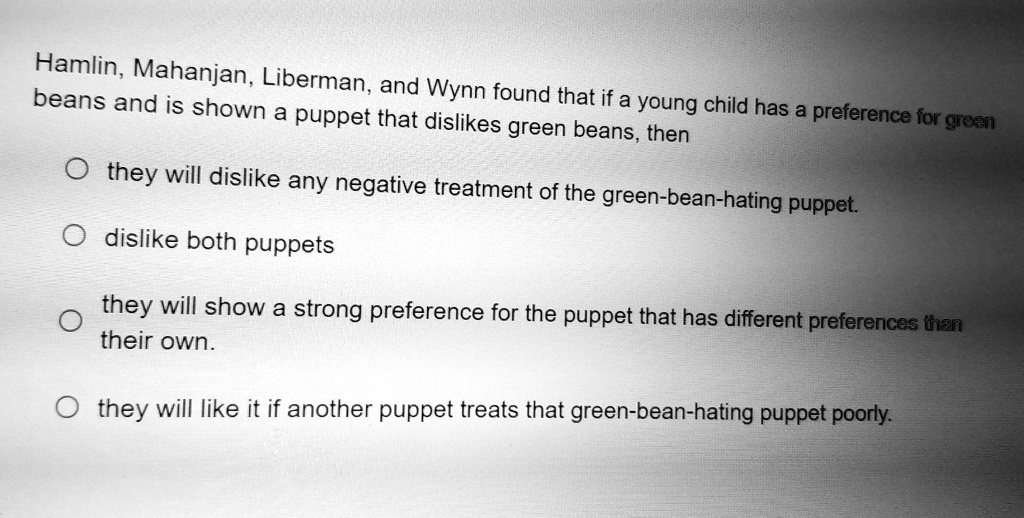
Hamlin, Mahanjan, Liberman, and Wynn found that if a young child has a preference for green beans and is shown a puppet that dislikes green beans, then ? they will dislike any negative treatment of the green-bean-hating puppet. ? dislike both puppets ? they will show a strong preference for the puppet that has different preferences than their own. ? they will like it if another puppet treats that green-bean-hating puppet poorly.
The Correct Answer and Explanation is:
Correct answer:
✔️ they will like it if another puppet treats that green-bean-hating puppet poorly.
Explanation:
The study conducted by Hamlin, Mahajan, Liberman, and Wynn investigated how young children form social evaluations based on shared or opposing preferences. In the experiment, children were shown puppets that expressed either a shared or differing food preference. For instance, if a child liked green beans and a puppet expressed dislike for green beans, the puppet was seen as holding an opposing preference.
What was especially revealing in the experiment was how children reacted to interactions between puppets. After establishing preference alignment or opposition, another puppet would act either kindly or meanly toward the first puppet. The children consistently preferred the puppet that treated the “disagreeing” puppet poorly. In other words, if a puppet disliked green beans (opposite to the child’s preference), and another puppet treated that puppet meanly, children tended to favor the puppet that was mean.
This behavior indicates that young children are not just passively noticing differences in preference but are also actively forming judgments and alliances based on those differences. This suggests a kind of early bias or social alignment mechanism, where even toddlers prefer individuals (or puppets) who oppose those with differing preferences.
This outcome was surprising and counter to the assumption that children would universally prefer kindness. Instead, they appeared to approve of hostility when directed toward individuals with different preferences. This finding has implications for understanding the development of in-group favoritism and out-group negativity early in human development.
In summary, the study demonstrates that young children can form biased social preferences and are more likely to favor individuals who are unkind to others with opposing likes, reflecting an early-rooted tendency toward group loyalty and preference-based social alignment.
