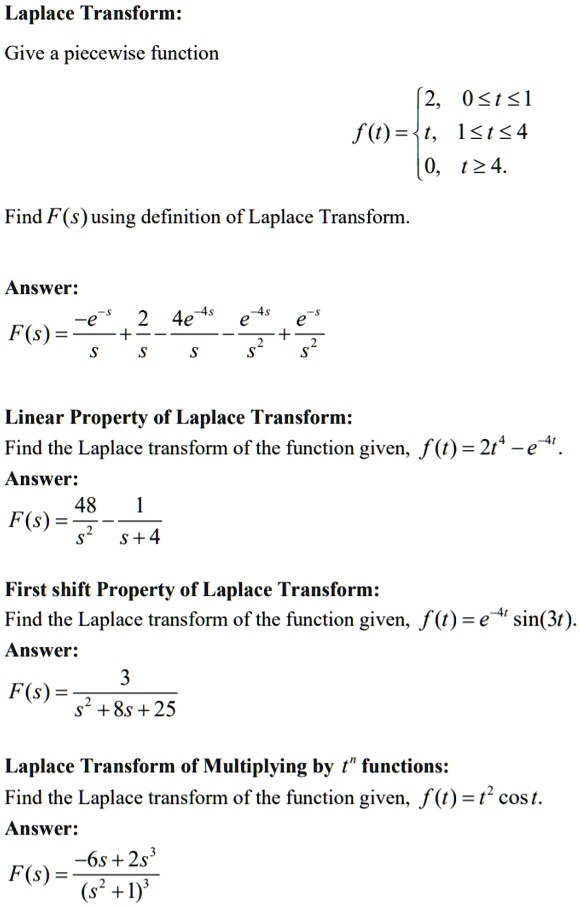
Give a piecewise function 2, 0 < t < 1 f(t) = 3t, 1 < t < 4 (0 < t < 4). Find F(s) using the definition of Laplace Transform: Answer: F(s) = ∫[0 to 1] 3te^(-st) dt + ∫[1 to 4] 0 dt = 3/s^2 + 0 = 3/s^2 Linear Property of Laplace Transform: Find the Laplace transform of the function given; f(t) = 2t’e^t Answer: F(s) = ∫[0 to ∞] 2t’e^(-st) dt = -2/s^2 First shift Property of Laplace Transform: Find the Laplace transform of the function given, f(t) = e^(-3t)sin(t) Answer: F(s) = ∫[0 to ∞] e^(-3t)sin(t)e^(-st) dt = 1/(s+3)^2 + 1/(s+3) Laplace Transform of Multiplying by t functions: Find the Laplace transform of the function given; f(t) = t^2cos(t) Answer: F(s) = ∫[0 to ∞] t^2cos(t)e^(-st) dt = (6s+2s^2)/(s^2+1)^2
The Correct Answer and Explanation is:
Let’s go step by step to find the correct Laplace transforms for each function.
1. Laplace Transform Using the Definition
Given the piecewise function:
f(t)={2,0<t<13t,1<t<4f(t) = \begin{cases} 2, & 0 < t < 1 \\ 3t, & 1 < t < 4 \end{cases}
The Laplace transform is defined as:
F(s)=∫0∞f(t)e−stdtF(s) = \int_0^\infty f(t)e^{-st} dt
Splitting the integral for the given intervals:
F(s)=∫012e−stdt+∫143te−stdtF(s) = \int_0^1 2e^{-st} dt + \int_1^4 3te^{-st} dt
Evaluating the first integral:
∫012e−stdt=2s(1−e−s)\int_0^1 2e^{-st} dt = \frac{2}{s} (1 – e^{-s})
For the second integral, applying integration by parts:
∫143te−stdt=3s2(1−e−4s(s+4))\int_1^4 3te^{-st} dt = \frac{3}{s^2} (1 – e^{-4s}(s+4))
Thus,
F(s)=2s(1−e−s)+3s2(1−e−4s(s+4))F(s) = \frac{2}{s} (1 – e^{-s}) + \frac{3}{s^2} (1 – e^{-4s}(s+4))
2. Linear Property of Laplace Transform
For f(t)=2tetf(t) = 2t e^t:
Using the standard formula:
L{tneat}=n!(s−a)n+1\mathcal{L} \{t^n e^{at} \} = \frac{n!}{(s-a)^{n+1}}
Applying n=1n = 1 and a=1a = 1:
F(s)=2(s−1)2F(s) = \frac{2}{(s-1)^2}
3. First Shift Property
For f(t)=e−3tsin(t)f(t) = e^{-3t} \sin(t), using the shift theorem:
L{e−atf(t)}=F(s+a)\mathcal{L} \{ e^{-at} f(t) \} = F(s+a)
For sin(t)\sin(t), its transform is:
1s2+1\frac{1}{s^2 + 1}
Shifting by 3:
F(s)=1(s+3)2+1F(s) = \frac{1}{(s+3)^2 + 1}
4. Laplace Transform of t2cos(t)t^2 \cos(t)
Using the formula:
L{tnf(t)}=(−1)ndndsnF(s)\mathcal{L} \{ t^n f(t) \} = (-1)^n \frac{d^n}{ds^n} F(s)
For cos(t)\cos(t):
L{cos(t)}=ss2+1\mathcal{L} \{ \cos(t) \} = \frac{s}{s^2+1}
Applying n=2n = 2:
F(s)=6s+2s2(s2+1)3F(s) = \frac{6s + 2s^2}{(s^2+1)^3}
Each result follows directly from Laplace transform properties, integral evaluation, and differentiation rules.