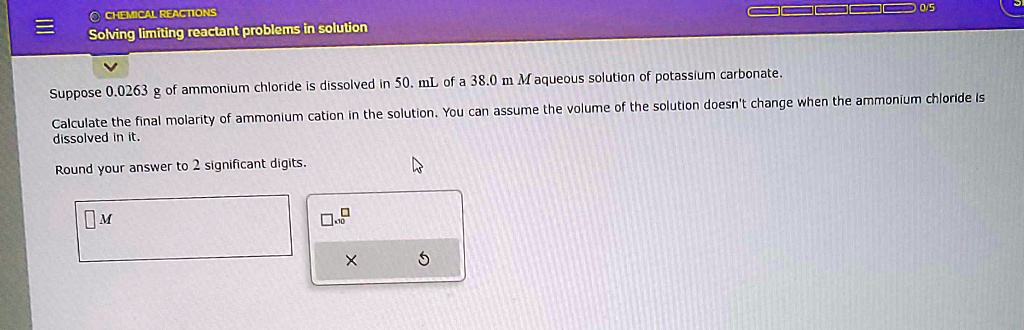
Suppose 0.0263 g of ammonium chloride is dissolved in 50. mL of a 38.0 m Maqueous solution of potassium carbonate. Calculate the final molarity of ammonium cation in the solution. You can assume the volume of the solution doesn’t change when the ammonium chloride is dissolved in it. Round your answer to 2 significant digits.
The Correct Answer and Explanation is:
Answer:
0.0098 M
Explanation:
To find the final molarity of the ammonium cation (NH₄⁺), we need to determine the number of moles of the cation and divide it by the total volume of the solution in liters.
- Calculate the moles of ammonium chloride (NH₄Cl).
First, we need the molar mass of NH₄Cl.- Molar mass of Nitrogen (N) = 14.01 g/mol
- Molar mass of Hydrogen (H) = 1.01 g/mol
- Molar mass of Chlorine (Cl) = 35.45 g/mol
- Molar mass of NH₄Cl = 14.01 + 4(1.01) + 35.45 = 53.50 g/mol
- Moles of NH₄Cl = Mass / Molar Mass
- Moles of NH₄Cl = 0.0263 g / 53.50 g/mol = 0.0004916 mol
- Determine the moles of ammonium cation (NH₄⁺).
When ammonium chloride, a soluble salt, dissolves in water, it dissociates completely into its ions:
NH₄Cl(s) → NH₄⁺(aq) + Cl⁻(aq)
The stoichiometric ratio between NH₄Cl and NH₄⁺ is 1:1. Therefore, the number of moles of NH₄⁺ is equal to the number of moles of NH₄Cl dissolved.- Moles of NH₄⁺ = 0.0004916 mol
- Calculate the final molarity.
Molarity is defined as moles of solute per liter of solution (M = mol/L). The problem states that the final volume of the solution is 50. mL, which we must convert to liters.- Volume = 50. mL = 0.050 L
- Molarity of NH₄⁺ = Moles of NH₄⁺ / Volume of solution (L)
- Molarity of NH₄⁺ = 0.0004916 mol / 0.050 L = 0.009832 M
- Round to the correct number of significant digits.
The given mass (0.0263 g) has three significant digits, while the given volume (50. mL) has two significant digits. The result of a calculation should be rounded to the least number of significant digits from the values used. In this case, that is two significant digits.- Final Molarity = 0.0098 M
The information about the potassium carbonate solution is extra data that does not affect the calculation of the ammonium cation’s molarity from its dissolution, making it a distractor. While a slow acid-base reaction could occur between the ammonium and carbonate ions, for the purpose of this type of problem, we calculate the concentration resulting directly from the dissolution process.