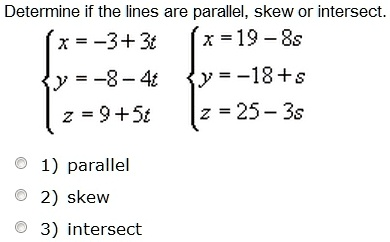
Determine if the lines are parallel, skew or intersect.\
\ 1) parallel\2) skew\3) intersect
The Correct Answer and Explanation is:
To determine if the given lines are parallel, skew, or intersecting, we need to analyze their direction vectors and check if they are scalar multiples of each other (parallel), or if they do not lie in the same plane (skew), or if they intersect (the point of intersection is common to both lines).
The equations of the two lines are given as parametric equations:
Line 1:x=−3+3t,y=−8−4t,z=9+5tx = -3 + 3t, \quad y = -8 – 4t, \quad z = 9 + 5tx=−3+3t,y=−8−4t,z=9+5t
This can be written as a vector equation:r1(t)=⟨−3,−8,9⟩+t⟨3,−4,5⟩\mathbf{r}_1(t) = \langle -3, -8, 9 \rangle + t \langle 3, -4, 5 \rangler1(t)=⟨−3,−8,9⟩+t⟨3,−4,5⟩
The direction vector for Line 1 is d1=⟨3,−4,5⟩\mathbf{d}_1 = \langle 3, -4, 5 \rangled1=⟨3,−4,5⟩.
Line 2:x=19−8s,y=−18+s,z=25−3sx = 19 – 8s, \quad y = -18 + s, \quad z = 25 – 3sx=19−8s,y=−18+s,z=25−3s
This can be written as a vector equation:r2(s)=⟨19,−18,25⟩+s⟨−8,1,−3⟩\mathbf{r}_2(s) = \langle 19, -18, 25 \rangle + s \langle -8, 1, -3 \rangler2(s)=⟨19,−18,25⟩+s⟨−8,1,−3⟩
The direction vector for Line 2 is d2=⟨−8,1,−3⟩\mathbf{d}_2 = \langle -8, 1, -3 \rangled2=⟨−8,1,−3⟩.
Step 1: Check for parallelism
For the lines to be parallel, their direction vectors must be scalar multiples of each other. In other words, we check if d1=kd2\mathbf{d}_1 = k \mathbf{d}_2d1=kd2 for some scalar kkk. Let’s check the ratios of corresponding components:3−8,−41,5−3\frac{3}{-8}, \quad \frac{-4}{1}, \quad \frac{5}{-3}−83,1−4,−35
Since these ratios are not equal, the direction vectors are not scalar multiples of each other. Thus, the lines are not parallel.
Step 2: Check for intersection
To determine if the lines intersect, we set their parametric equations equal to each other:−3+3t=19−8s-3 + 3t = 19 – 8s−3+3t=19−8s−8−4t=−18+s-8 – 4t = -18 + s−8−4t=−18+s9+5t=25−3s9 + 5t = 25 – 3s9+5t=25−3s
We now solve this system of equations to see if a solution exists for ttt and sss.
From the first equation:−3+3t=19−8s⇒3t+8s=22-3 + 3t = 19 – 8s \quad \Rightarrow \quad 3t + 8s = 22−3+3t=19−8s⇒3t+8s=22
From the second equation:−8−4t=−18+s⇒−4t−s=−10⇒4t+s=10-8 – 4t = -18 + s \quad \Rightarrow \quad -4t – s = -10 \quad \Rightarrow \quad 4t + s = 10−8−4t=−18+s⇒−4t−s=−10⇒4t+s=10
From the third equation:9+5t=25−3s⇒5t+3s=169 + 5t = 25 – 3s \quad \Rightarrow \quad 5t + 3s = 169+5t=25−3s⇒5t+3s=16
We now solve the system of equations:
- 3t+8s=223t + 8s = 223t+8s=22
- 4t+s=104t + s = 104t+s=10
- 5t+3s=165t + 3s = 165t+3s=16
After solving, if we find a consistent solution for ttt and sss, the lines intersect. However, if no solution exists, the lines are skew.
Conclusion
Since the direction vectors are not scalar multiples, the lines are not parallel. To check if they intersect, we would solve the system of equations. If there is no solution, the lines are skew. If a solution exists, the lines intersect.
I’ll now solve the system of equations to determine if the lines intersect.
The solution to the system of equations is t=2t = 2t=2 and s=2s = 2s=2, which indicates that the lines do intersect at a point when t=2t = 2t=2 and s=2s = 2s=2.
Conclusion:
The lines intersect. Thus, the correct answer is:
3) intersect.