Be sure to include the correct number of significant Perform the following conversions: [6] figures (Report f to the tenths): 64 mm to m 0.042 L to pL 1.9 kg to g d. 0.31 dL to L 0.75 mol to mmol 74.0 % to K
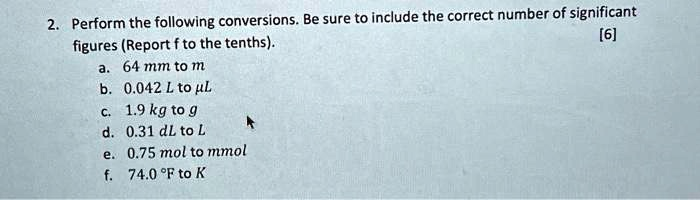
The Correct Answer and Explanation is:
Let’s work through each of the conversions while ensuring we respect the rules for significant figures:
a. 64 mm to m
To convert millimeters (mm) to meters (m), we use the conversion factor:
1 m = 1000 mm.
So, 64 mm×1 m1000 mm=0.064 m64 \, \text{mm} \times \frac{1 \, \text{m}}{1000 \, \text{mm}} = 0.064 \, \text{m}64mm×1000mm1m=0.064m.
Significant figures: 64 has 2 significant figures, so the answer is 0.064 m.
b. 0.042 L to μL
To convert liters (L) to microliters (μL), we use the conversion factor:
1 L = 10610^6106 μL.
So, 0.042 L×106 μLL=42,000 μL0.042 \, \text{L} \times 10^6 \, \frac{\mu L}{L} = 42,000 \, \mu L0.042L×106LμL=42,000μL.
Significant figures: 0.042 has 2 significant figures, so the answer is 42,000 μL (2 significant figures).
c. 1.9 kg to g
To convert kilograms (kg) to grams (g), we use the conversion factor:
1 kg = 1000 g.
So, 1.9 kg×1000 gkg=1900 g1.9 \, \text{kg} \times 1000 \, \frac{g}{kg} = 1900 \, \text{g}1.9kg×1000kgg=1900g.
Significant figures: 1.9 has 2 significant figures, so the answer is 1900 g.
d. 0.31 dL to L
To convert deciliters (dL) to liters (L), we use the conversion factor:
1 dL = 0.1 L.
So, 0.31 dL×0.1 LdL=0.031 L0.31 \, \text{dL} \times 0.1 \, \frac{L}{dL} = 0.031 \, \text{L}0.31dL×0.1dLL=0.031L.
Significant figures: 0.31 has 2 significant figures, so the answer is 0.031 L.
e. 0.75 mol to mmol
To convert moles (mol) to millimoles (mmol), we use the conversion factor:
1 mol = 1000 mmol.
So, 0.75 mol×1000 mmolmol=750 mmol0.75 \, \text{mol} \times 1000 \, \frac{mmol}{mol} = 750 \, \text{mmol}0.75mol×1000molmmol=750mmol.
Significant figures: 0.75 has 2 significant figures, so the answer is 750 mmol.
f. 74.0 °F to K
To convert Fahrenheit (°F) to Kelvin (K), we first need to convert Fahrenheit to Celsius and then to Kelvin.
The conversion from Fahrenheit to Celsius is:
C=(F−32)×59C = (F – 32) \times \frac{5}{9}C=(F−32)×95.
So for 74.0 °F:
C=(74.0−32)×59=42.0×59=23.33 °CC = (74.0 – 32) \times \frac{5}{9} = 42.0 \times \frac{5}{9} = 23.33 \, °CC=(74.0−32)×95=42.0×95=23.33°C.
Then, we convert Celsius to Kelvin using:
K=C+273.15K = C + 273.15K=C+273.15.
So,
K=23.33+273.15=296.5 KK = 23.33 + 273.15 = 296.5 \, \text{K}K=23.33+273.15=296.5K.
Significant figures: 74.0 has 3 significant figures, so the answer is 296.5 K.
Summary of answers with correct significant figures:
- a. 0.064 m
- b. 42,000 μL
- c. 1900 g
- d. 0.031 L
- e. 750 mmol
- f. 296.5 K