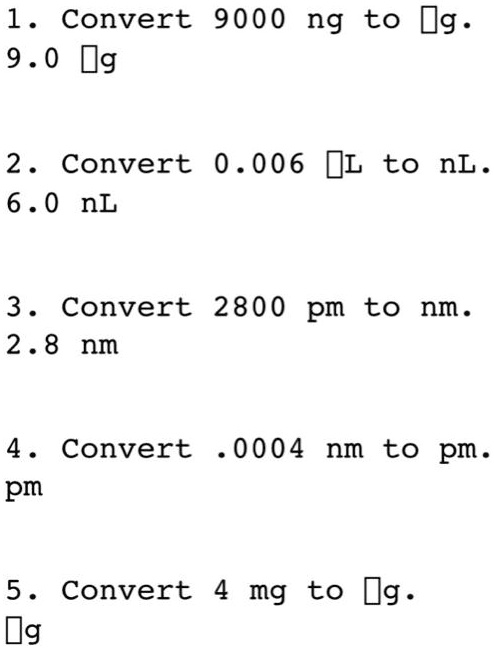
. Convert 9000 ng to g. 9.0 g 2. Convert 0.006 L to nL. 6.0 nL 3. Convert 2800 pm to nm. 2.8 nm 4. Convert .0004 nm to pm. pm 5. Convert 4 mg to g. 0 g
The Correct Answer and Explanation is:
Based on the provided image, here are the correct answers for the incomplete conversion problems:
4. Convert .0004 nm to pm.
0.4 pm
5. Convert 4 mg to µg.
4000 µg
Explanation
These problems require an understanding of metric system prefixes, which are used to denote multiples or fractions of base units like grams (g), liters (L), and meters (m). The conversions in this exercise primarily involve moving between prefixes that are separated by a factor of 1,000 (or 10³).
The key prefixes in these questions are:
- milli (m), representing one-thousandth (10⁻³)
- micro (µ), representing one-millionth (10⁻⁶)
- nano (n), representing one-billionth (10⁻⁹)
- pico (p), representing one-trillionth (10⁻¹²)
A simple rule for these specific prefixes is that each is 1,000 times smaller than the one before it.
- 1 milligram (mg) = 1,000 micrograms (µg)
- 1 microgram (µg) = 1,000 nanograms (ng)
- 1 nanometer (nm) = 1,000 picometers (pm)
When converting from a larger unit to a smaller unit, you multiply by 1,000. When converting from a smaller unit to a larger unit, you divide by 1,000.
Calculation for Problem 4: Convert .0004 nm to pm.
We are converting from nanometers (nm) to picometers (pm). A nanometer is a larger unit than a picometer. Specifically, 1 nm is equal to 1,000 pm. To make this conversion, we must multiply the given value by 1,000.
Calculation: 0.0004 nm × 1,000 = 0.4 pm.
Calculation for Problem 5: Convert 4 mg to µg.
The problem asks to convert 4 mg to “[]g”. Based on the pattern of prefixes, the missing symbol “[]” represents the micro (µ) prefix. We are converting from milligrams (mg) to micrograms (µg). A milligram is a larger unit than a microgram; 1 mg is equal to 1,000 µg. Therefore, we multiply the value by 1,000.
Calculation: 4 mg × 1,000 = 4,000 µg.
The answers provided for the first three problems are also correct and follow the same logic. For instance, in problem 1, converting 9000 ng to µg requires dividing by 1,000 (9000 / 1000 = 9.0), since you are moving from a smaller unit (nano) to a larger one (micro).