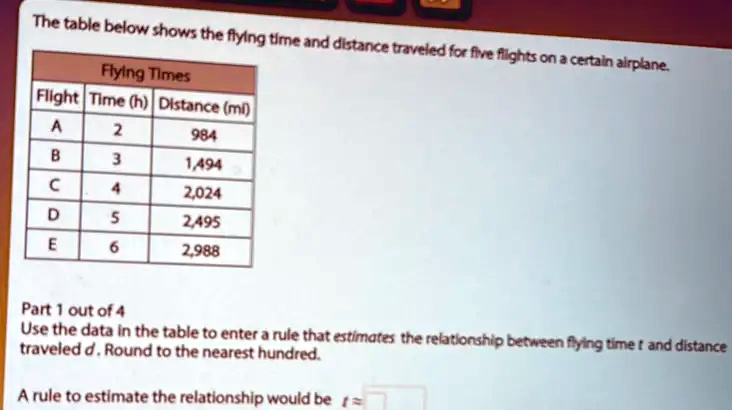
The table below shows the flying time and distance traveled for five flights on a certain airplane. Flying Times Flight Time (h) Distance (mi) A 2 984 B 3 1,494 C 4 2,024 D 5 2,495 E 6 2,988 Part 1 out of 4 Use the data in the table to enter a rule that estimates the relationship between flying time
and distance traveled
. Round to the nearest hundred. A rule to estimate the relationship would be
The Correct Answer and Explanation is:
Correct Answer:
d = 500t
Explanation
To determine the rule that estimates the relationship between the flying time (t, in hours) and the distance traveled (d, in miles), we first analyze the data provided in the table. The problem suggests finding an estimation, which often implies a linear or proportional relationship. In this context, the relationship between distance, speed, and time is fundamental. The formula is distance = speed × time, or d = s × t. Since the time and distance change for each flight, we can assume the airplane travels at a roughly constant average speed. Our task is to determine a single, estimated value for this speed.
We can calculate the plane’s average speed for each individual flight by dividing the distance traveled by the flying time (s = d/t).
- For Flight A: 984 mi / 2 h = 492 mph
- For Flight B: 1,494 mi / 3 h = 498 mph
- For Flight C: 2,024 mi / 4 h = 506 mph
- For Flight D: 2,495 mi / 5 h = 499 mph
- For Flight E: 2,988 mi / 6 h = 498 mph
The calculated speeds are all very close to each other, which confirms that a constant speed is a reasonable assumption for creating an estimation rule. To find the best single value for this speed, we can calculate the average of these five speeds:
Average Speed = (492 + 498 + 506 + 499 + 498) / 5 = 2493 / 5 = 498.6 mph.
The problem includes a specific instruction to round the value used in the rule to the nearest hundred. We must apply this rounding to our calculated average speed. Rounding 498.6 to the nearest hundred gives 500, as 498.6 is much closer to 500 than to 400.
Now, we substitute this rounded speed into our general formula (d = s × t) to create the final estimation rule:
d = 500t
This rule effectively estimates the distance traveled by the airplane for a given flying time.thumb_upthumb_down