A half-circle of wire of length
and mass
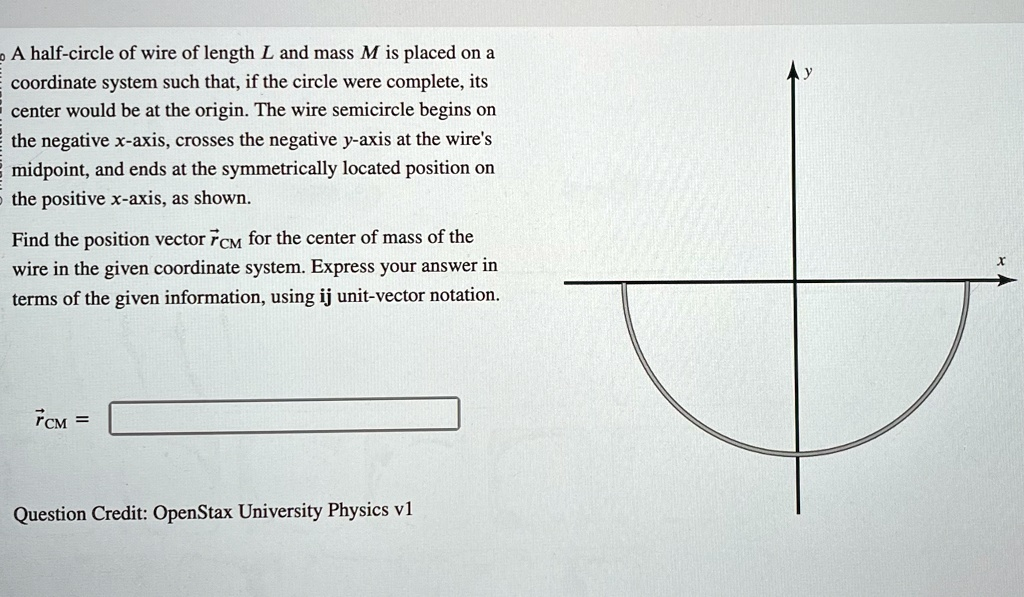
is placed on a coordinate system such that, if the circle were complete, its center would be at the origin. The wire semicircle begins on the negative x-axis, crosses the negative y-axis at the wire’s midpoint, and ends at the symmetrically located position on the positive x-axis, as shown. Find the position vector
for the center of mass of the wire in the given coordinate system. Express your answer in terms of the given information, using ij unit-vector notation.
= Question Credit: OpenStax University Physics v1
The Correct Answer and Explanation is:
Here is the final answer:
r<sub>CM</sub> = -(2L / π²) j
Explanation:
To find the center of mass (r<sub>CM</sub>) of the semicircular wire, we need to determine its coordinates, x<sub>CM</sub> and y<sub>CM</sub>. The position vector is then given by r<sub>CM</sub> = x<sub>CM</sub>i + y<sub>CM</sub>j.
1. Finding the x-coordinate (x<sub>CM</sub>):
The problem states that the wire is a semicircle that begins on the negative x-axis, crosses the negative y-axis, and ends on the positive x-axis. This shape is perfectly symmetric with respect to the y-axis. For every small piece of mass at a position x, there is an identical piece of mass at -x. Due to this symmetry, the x-coordinates cancel each other out when calculating the average position. Therefore, the x-coordinate of the center of mass is zero.
x<sub>CM</sub> = 0
2. Finding the y-coordinate (y<sub>CM</sub>):
The y-coordinate of the center of mass is found using the integral formula:
y<sub>CM</sub> = (1/M) ∫ y dm
To solve this, we first need to relate the variables. Let the radius of the semicircle be R. The given length of the wire, L, is the circumference of the semicircle, so L = πR. We can express the radius in terms of the given length: R = L/π.
We can describe any point on the wire using polar coordinates, where y = R sin(θ). The differential mass element, dm, is the linear mass density (λ) times the differential arc length (ds). The linear mass density is λ = M/L, and the arc length is ds = R dθ. So, dm = λ ds = (M/L) R dθ.
Substituting these into the integral, and noting that the angle θ for the lower semicircle goes from π to 2π, we get:
y<sub>CM</sub> = (1/M) ∫<sub>π</sub><sup>2π</sup> (R sin(θ)) * (M/L * R) dθ
y<sub>CM</sub> = (R²/L) ∫<sub>π</sub><sup>2π</sup> sin(θ) dθ
Integrating sin(θ) gives -cos(θ):
y<sub>CM</sub> = (R²/L) [-cos(θ)]<sub>π</sub><sup>2π</sup>
y<sub>CM</sub> = (R²/L) [-cos(2π) – (-cos(π))]
y<sub>CM</sub> = (R²/L) [-1 – (-(-1))] = (R²/L) [-1 – 1] = -2R²/L
Now, we substitute R = L/π to express the answer in terms of the given variable L:
y<sub>CM</sub> = -2(L/π)² / L = -2(L²/π²) / L = -2L/π²
3. Constructing the Position Vector:
With x<sub>CM</sub> = 0 and y<sub>CM</sub> = -2L/π², the position vector for the center of mass is:
r<sub>CM</sub> = 0i + (-2L/π²) j = -(2L/π²) j