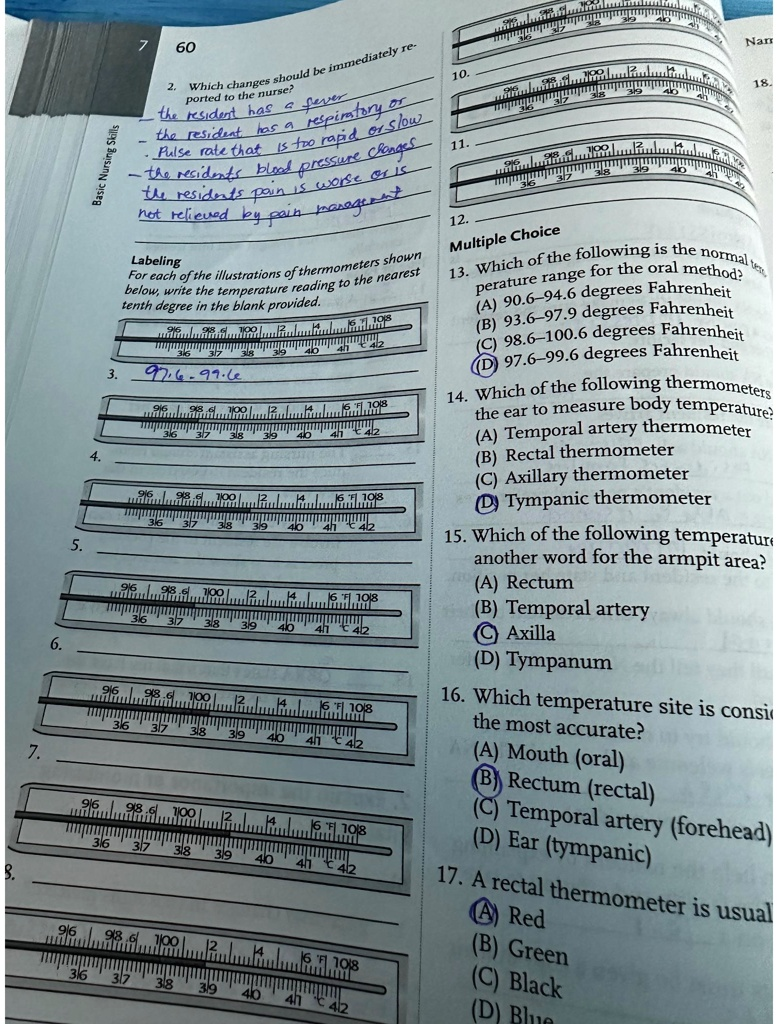
Which changes should be immediately reported to the nurse? the resident has a respiratory or Pulse rate that is too rapid or slow the resident’s pain is worse not relieved by pain manager Labeling For each of the illustrations of thermometers shown below, write the temperature reading to the nearest tenth degree in the blank provided. 3. 97.6 Multiple Choice 13. Which of the following is the normal temperature range for the oral method? (A) 90.6-94.6 degrees Fahrenheit (B) 93.6-97.9 degrees Fahrenheit (C) 98.6-100.6 degrees Fahrenheit Which of the following thermometers uses the ear to measure body temperature? (A) Temporal artery thermometer (B) Rectal thermometer (C) Axillary thermometer (D) Tympanic thermometer 15. Which of the following temperature sites is another word for the armpit area? (A) Rectum (B) Temporal artery (C) Axilla (D) Tympanum 16. Which temperature site is considered the most accurate? (A) Mouth (oral) (B) Rectum (rectal) (C) Temporal artery (forehead) (D) Ear (tympanic) 17. A rectal thermometer is usually (A) Red (B) Green (C) Black (D) Blue
The Correct Answer and Explanation is:
Based on the nursing skills worksheet provided, here are the correct answers and a detailed explanation for each section.
Correct Answers
Question 2: Changes to Report Immediately
The handwritten answers are correct. A nursing assistant should immediately report:
- The resident has a fever.
- The resident has a respiratory or pulse rate that is too rapid or too slow.
- The resident’s blood pressure changes significantly.
- The resident’s pain is worse or is not relieved by pain management.
Labeling: Thermometer Readings
To read these thermometers correctly, note that the long lines indicate odd-numbered degrees and the small tick marks each represent two-tenths of a degree (0.2°F).
- 3. 97.6°F
- 4. 99.2°F
- 5. 101.0°F
- 6. 103.2°F
- 7. 99.4°F
- 8. 102.0°F
Multiple Choice
- 13. (D) 97.6–99.6 degrees Fahrenheit
- 14. (D) Tympanic thermometer
- 15. (C) Axilla
- 16. (B) Rectum (rectal)
- 17. (A) Red
Explanation
This worksheet assesses critical knowledge for healthcare professionals regarding vital signs, particularly temperature.
For question 2, the listed conditions represent potentially serious changes in a resident’s health. A fever can signal an infection. Abnormal pulse, respiration, or blood pressure can indicate cardiac, circulatory, or respiratory distress. Worsening pain requires reassessment and intervention. Prompt reporting of these signs is essential for patient safety.
The thermometer labeling section tests the ability to read an analog glass thermometer. The Fahrenheit scale on these devices has numbered markings for even degrees. Between each even number, a long line marks the odd degree. The smaller lines between each whole degree represent increments of 0.2 degrees. For example, the reading for thermometer number 7 shows the line two small marks past the long line for 99, which corresponds to a temperature of 99.4°F.
The multiple choice section covers key facts about thermometry. For question 13, the standard normal range for an oral temperature in an adult is 97.6°F to 99.6°F, making option (D) correct. For question 14, a tympanic thermometer is specifically designed to measure temperature from the tympanic membrane inside the ear canal. For question 15, “axilla” is the correct medical term for the armpit area. For question 16, the rectal site is considered the most accurate for measuring temperature because it provides a core body temperature reading, which is less influenced by external factors like drinking hot or cold liquids. Finally, for question 17, rectal thermometers are conventionally colored red at the end. This color coding is a critical safety feature to prevent them from being accidentally used for oral measurements, thus avoiding cross contamination