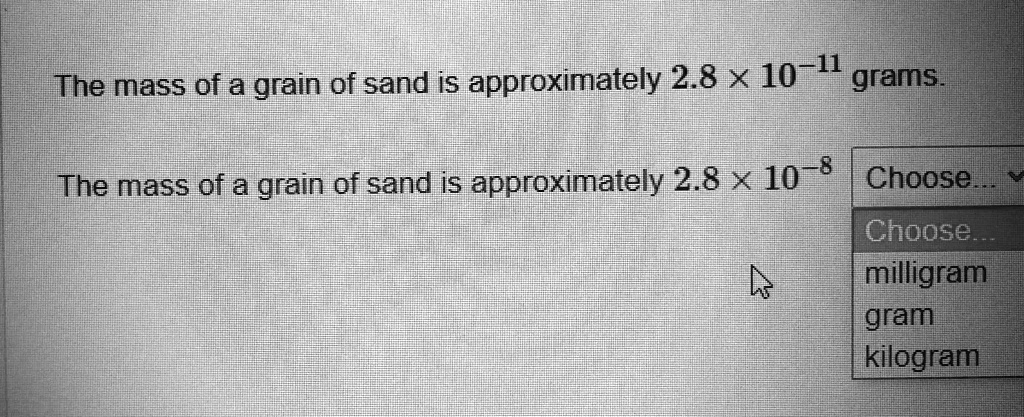
The mass of a grain of sand is approximately 2.8 x 10⁻¹¹
grams. The mass of a grain of sand is approximately
Choose… Choose… milligram gram kilogram
The Correct Answer and Explanation is:
The correct answer is milligram.
The problem requires us to find the correct unit of mass that equates two statements about the mass of a grain of sand. This is a unit conversion problem that involves working with scientific notation and the metric system.
The first statement gives us the reference value:
The mass of a grain of sand is approximately 2.8 x 10⁻¹¹ grams.
The second statement presents the same mass but with a different numerical value, and we must find the corresponding unit:
The mass of a grain of sand is approximately 2.8 x 10⁻⁸ [unit].
To solve this, we can convert the initial value from grams into each of the potential units (milligram, gram, kilogram) to see which conversion yields the numerical value 2.8 x 10⁻⁸.
First, let’s establish the relationships between the metric units of mass:
- 1 gram (g) = 1,000 milligrams (mg)
- 1 kilogram (kg) = 1,000 grams (g)
This also means:
- To convert grams to milligrams, you multiply by 1,000 (or 10³).
- To convert grams to kilograms, you divide by 1,000 (or multiply by 10⁻³).
Let’s perform the conversion from grams to milligrams:
Mass in milligrams = (Mass in grams) × 1,000
Mass in milligrams = (2.8 × 10⁻¹¹) × 10³
When multiplying numbers in scientific notation with the same base (in this case, 10), we add their exponents.
Exponent calculation: (-11) + 3 = -8.
So, the mass is 2.8 × 10⁻⁸ milligrams.
This result, 2.8 × 10⁻⁸, exactly matches the number in the second statement. This confirms that the correct unit is the milligram.
For the sake of thoroughness, if the unit were kilograms, the calculation would be:
Mass in kilograms = (Mass in grams) ÷ 1,000
Mass in kilograms = (2.8 × 10⁻¹¹) × 10⁻³
Exponent calculation: (-11) + (-3) = -14.
The result would be 2.8 × 10⁻¹⁴ kilograms, which does not match. Therefore, milligram is the only correct choice.