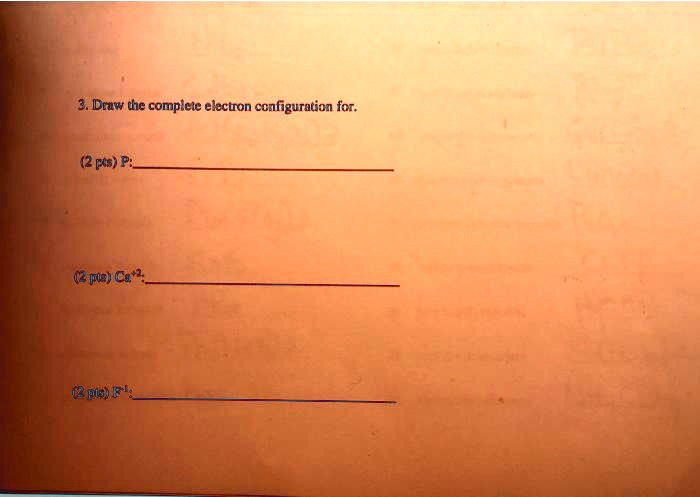
Draw the complete electron configuration for. (2 pts) P: (2 pts) Ca
(2 pts)
The Correct Answer and Explanation is:
Here are the correct complete electron configurations for the specified atom and ions.
P: 1s²2s²2p⁶3s²3p³
Ca²⁺: 1s²2s²2p⁶3s²3p⁶
F¹⁻: 1s²2s²2p⁶
Explanation
Electron configuration is a standardized notation that describes the arrangement of electrons within the orbitals of an atom or ion. This arrangement is governed by the Aufbau principle, which states that electrons fill the lowest energy orbitals first. The order of filling is generally 1s, 2s, 2p, 3s, 3p, 4s, 3d, and so on.
Phosphorus (P):
To determine the electron configuration for a neutral phosphorus atom, we first find its atomic number on the periodic table, which is 15. In a neutral atom, the number of electrons is equal to the atomic number, so phosphorus has 15 electrons. We fill the orbitals in order of increasing energy until all 15 electrons are placed:
- The 1s orbital holds 2 electrons (1s²).
- The 2s orbital holds 2 electrons (2s²).
- The 2p orbital holds 6 electrons (2p⁶).
- The 3s orbital holds 2 electrons (3s²).
- The remaining 3 electrons go into the 3p orbital (3p³).
Combining these gives the complete configuration for phosphorus: 1s²2s²2p⁶3s²3p³.
Calcium ion (Ca²⁺):
First, consider a neutral calcium (Ca) atom, which has an atomic number of 20, meaning it has 20 electrons. The configuration is 1s²2s²2p⁶3s²3p⁶4s². The Ca²⁺ ion has a +2 charge, which signifies that the neutral atom has lost two electrons. Atoms lose their outermost, highest-energy valence electrons first. For calcium, these are the two electrons in the 4s orbital. After removing these two electrons, the ion has 18 electrons. The resulting configuration is 1s²2s²2p⁶3s²3p⁶. This configuration is stable because it is isoelectronic with the noble gas Argon (Ar).
Fluoride ion (F¹⁻):
A neutral fluorine (F) atom has an atomic number of 9, meaning it has 9 electrons. Its configuration is 1s²2s²2p⁵. The F¹⁻ ion (often written as F⁻) has a -1 charge, indicating it has gained one electron. This extra electron is added to the outermost, partially filled orbital to achieve a more stable state. The 2p orbital, which had 5 electrons, now accepts one more to become completely filled. The ion now has a total of 10 electrons. The final electron configuration for the fluoride ion is 1s²2s²2p⁶. This is also a stable configuration, as it is isoelectronic with the noble gas Neon (Ne).