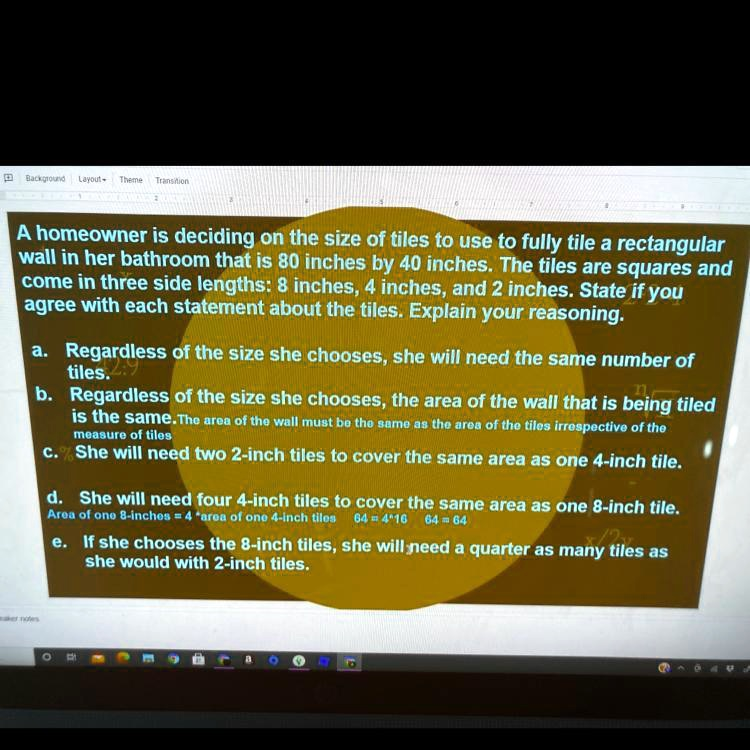
A homeowner is deciding on the size of tiles to use to fully tile a rectangular wall in her bathroom that is 80 inches by 40 inches. The tiles are squares and come in three side lengths: 8 inches, 4 inches, and 2 inches. State if you agree with each statement about the tiles. Explain your reasoning. a. Regardless of the size she chooses, she will need the same number of tiles. b. Regardless of the size she chooses, the area of the wall that is being tiled is the same. The area of the wall must be the same as the area of the tiles irrespective of the measure of tiles c. She will need two 2-inch tiles to cover the same area as one 4-inch tile. d. She will need four 4-inch tiles to cover the same area as one 8-inch tile. Area of one 8-inches = 4 *area of one 4-inch tiles 64 = 4 * 16 64 = 64 e. If she chooses the 8-inch tiles, she will need a quarter as many tiles as she would with 2-inch tiles.
The Correct Answer and Explanation is:
Of course. Here is the correct answer for each statement with a detailed explanation.
First, let’s establish the key information. The wall’s area is constant, calculated by multiplying its dimensions: 80 inches × 40 inches = 3200 square inches. The area of each square tile is its side length multiplied by itself.
- 8-inch tile area: 8 × 8 = 64 square inches.
- 4-inch tile area: 4 × 4 = 16 square inches.
- 2-inch tile area: 2 × 2 = 4 square inches.
a. Disagree. The number of tiles needed depends directly on the size of the tile. Smaller tiles cover less area, so more of them are required to cover the same 3200 square inch wall. To prove this, we can calculate the number of tiles needed for each size:
- 8-inch tiles needed: 3200 / 64 = 50 tiles.
- 4-inch tiles needed: 3200 / 16 = 200 tiles.
- 2-inch tiles needed: 3200 / 4 = 800 tiles.
Clearly, 50, 200, and 800 are not the same number.
b. Agree. The wall itself does not change. Its dimensions are fixed at 80 inches by 40 inches. Therefore, the total area that needs to be covered by tiles is always 3200 square inches, regardless of which tile size the homeowner chooses to use for the project.
c. Disagree. This statement confuses linear measurement with area. A 4-inch tile has an area of 16 square inches (4 × 4). A 2-inch tile has an area of 4 square inches (2 × 2). Two 2-inch tiles would only cover a total of 8 square inches (2 × 4). To cover the same area as one 4-inch tile, she would need four 2-inch tiles (4 tiles × 4 square inches/tile = 16 square inches).
d. Agree. The area of one 8-inch tile is 64 square inches (8 × 8). The area of one 4-inch tile is 16 square inches (4 × 4). If she uses four 4-inch tiles, the total area covered would be 4 × 16 = 64 square inches. This is exactly the same area as a single 8-inch tile.
e. Disagree. As calculated for statement (a), she would need 50 of the 8-inch tiles and 800 of the 2-inch tiles. A quarter of 800 tiles is 200 (800 / 4). Since she only needs 50 of the 8-inch tiles, which is not 200, the statement is false. The relationship is based on area, not side length. The 8-inch tile has 16 times the area of the 2-inch tile (64 / 4 = 16), so she needs 1/16th as many, not 1/4