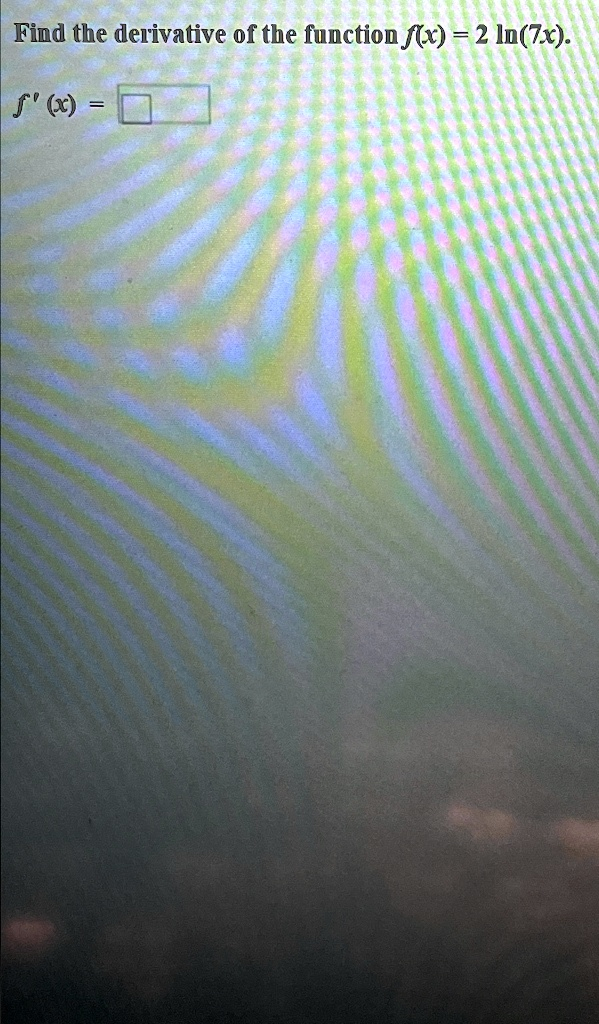
Find the derivative of the function f(x)=2ln(7x)
The Correct Answer and Explanation is:
The correct answer is f'(x) = 2/x.
To find the derivative of the function f(x) = 2 ln(7x), we need to apply the rules of differentiation, specifically the Constant Multiple Rule and the Chain Rule.
- Constant Multiple Rule: The function can be seen as a constant (2) multiplied by a function (ln(7x)). The Constant Multiple Rule states that the derivative of c * g(x) is c * g'(x). Therefore, we can write:
f'(x) = 2 * d/dx[ln(7x)] - Chain Rule: The term ln(7x) is a composite function. The outer function is the natural logarithm, ln(u), and the inner function is u = 7x. The Chain Rule states that the derivative of a composite function is the derivative of the outer function (with respect to the inner function) multiplied by the derivative of the inner function.
- The derivative of the outer function, ln(u), is 1/u.
- The derivative of the inner function, 7x, is 7.
d/dx[ln(7x)] = (1 / 7x) * 7 - Simplify and Combine: Now, we simplify the expression from the Chain Rule:
(1 / 7x) * 7 = 7 / (7x) = 1/xFinally, we multiply this result by the constant 2 from the first step:
f'(x) = 2 * (1/x) = 2/x
Alternative Method (Using Logarithm Properties):
We can also simplify the function first using the logarithm property ln(ab) = ln(a) + ln(b):
f(x) = 2 ln(7x) = 2[ln(7) + ln(x)] = 2ln(7) + 2ln(x)
Now, we can differentiate this expression term by term:
f'(x) = d/dx[2ln(7)] + d/dx[2ln(x)]
Since 2ln(7) is a constant, its derivative is 0. The derivative of 2ln(x) is 2 * (1/x) = 2/x.
f'(x) = 0 + 2/x = 2/x
Both methods yield the same result, confirming that the derivative of f(x) = 2 ln(7x) is f'(x) = 2/x.