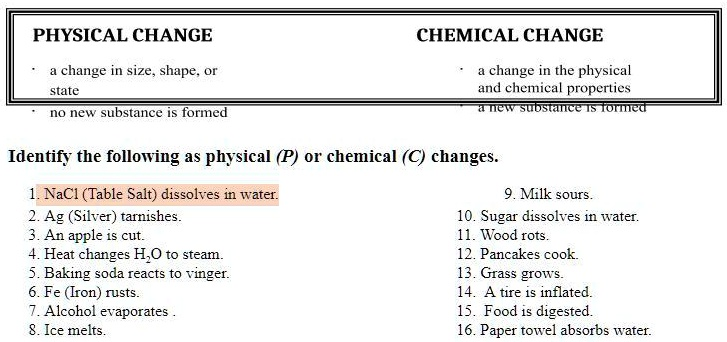
PHYSICAL CHANGE \ a change in size, shape, or state \ no new substance is formed CHEMICAL CHANGE \ a change in the physical and chemical properties \ a new substance is formed Identify the following as physical (P) or chemical (C) changes. 1. NaCl (Table Salt) dissolves in water. 2. Ag (Silver) tarnishes. 3. An apple is cut. 4. Heat changes H2O to steam. 5. Baking soda reacts to vinger. 6. Fe (Iron) rusts. 7. Alcohol evaporates. 8. Ice melts. 9. Milk sours. 10. Sugar dissolves in water. 11. Wood rots. 12. Pancakes cook. 13. Grass grows. 14. A tire is inflated. 15. Food is digested. 16. Paper towel absorbs water.
The Correct Answer and Explanation is:
Physical Change)
The process of NaCl (Table Salt) dissolving in water is a physical change.
According to the provided definitions, a physical change involves a change in size, shape, or state, but critically, no new substance is formed. When table salt, an ionic compound, is placed in water, it undergoes a process called dissociation. The polar water molecules surround the individual sodium (Na+) and chloride (Cl-) ions, pulling them away from the solid crystal lattice structure. The salt changes its state from a solid to an aqueous (dissolved) state, and its form changes from visible crystals to invisible ions dispersed throughout the water.
However, the fundamental chemical identity of the components remains the same. The solution contains water molecules (H₂O), sodium ions (Na+), and chloride ions (Cl-). No new chemical bonds have been formed to create entirely new molecules or compounds. The change is also easily reversible, which is a common characteristic of physical changes. If the water is evaporated from the solution, the sodium and chloride ions will recombine to form the original solid salt (NaCl) again.
This contrasts with a chemical change, such as baking soda reacting with vinegar (item 5) or iron rusting (item 6). In those examples, the original substances are consumed, and entirely new substances with different chemical properties (carbon dioxide gas, iron oxide) are produced through chemical reactions. Since dissolving salt only alters its physical state and does not create a new substance, it is correctly classified as a physical change.