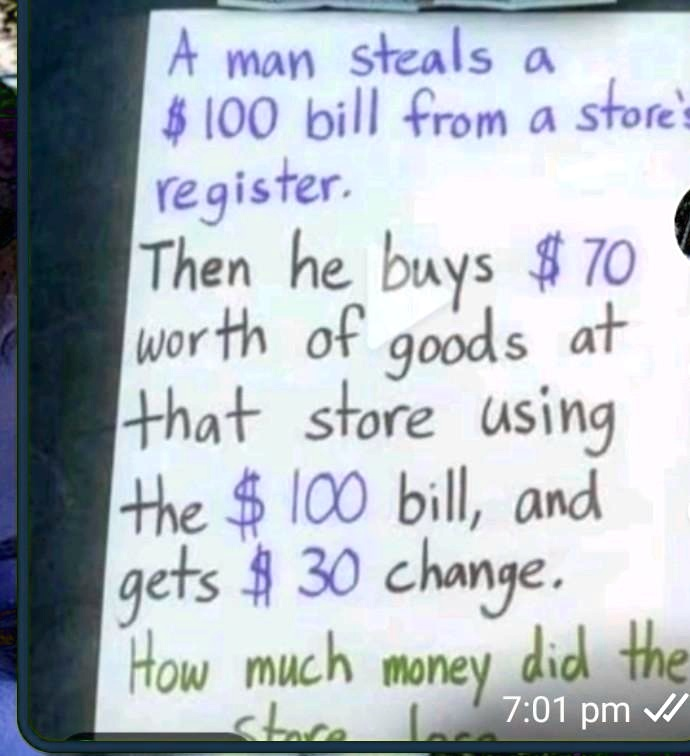
The Correct Answer and Explanation is:
Based on the handwritten riddle in the image, here is the correct answer and a detailed explanation.
The correct answer is—$100.
This classic riddle is designed to be confusing by mixing two events—a theft and a transaction—to trick you into double-counting the losses. Many people arrive at incorrect answers like $170 or $200 by adding the initial theft to the value of the goods and the change. However, a careful breakdown of the events reveals the true loss.
The simplest way to solve this is to look at what the store is missing at the very end of the scenario. The store lost two things of $100 bill from a store’s register.
Then he buys $70 worth of goods at that store using the $100 bill, and gets $30 change.
How much money did the store lose?”
The correct answer is that the store lost $100.
Explanation:
This riddle is designed to confuse you by mixing two events—a theft and a transaction—and making it seem more complicated than it is. The key is to track what value actually left the store and was never legitimately replaced. There are two simple ways to arrive at the correct answer.
Method 1: Focus on the Thief’s Gain
The simplest way to solve this is to look at the situation from the thief’s perspective. Everything the thief gained is a direct loss for the store, as he provided nothing of his own value in return.
- The thief starts with nothing.
- By the end of the events, the thief walks away with
70worthofgoods∗∗and∗∗70worthofgoods∗∗and∗∗30 in cash (the change). - The total value the thief has acquired is $70 (goods) +
30(cash)=∗∗30(cash)=∗∗100**.
Since the thief started with nothing and left with $100 worth of assets (goods and cash), the store must have lost exactly that amount. The $100 bill he stole and then used for the purchase was just a tool to convert his theft of a single bill into a theft of both merchandise and different cash.
Method 2: Track the Store’s Assets
Let’s break down the store’s losses step-by-step from the store’s point of view.
- The Theft: A
100billisstolenfromtheregister.Atthismoment,thestoreisdown∗∗100billisstolenfromtheregister.Atthismoment,thestoreisdown∗∗100 in cash**. - The Transaction: The thief returns to the store to “buy” items.
- He hands the stolen $100 bill back to the cashier. For a moment, the register’s cash is restored. The initial $100 cash loss is seemingly nullified.
- The store then gives the man $70 worth of goods. This is a loss of $70 in inventory.
- The store then gives the man $30 in change from the register. This is a loss of $30 in cash.
When you tally the final net loss for the store, you have the value of the goods that walked out the door (
70)andthecashgivenaschangethatalsowalkedoutthedoor(70)andthecashgivenaschangethatalsowalkedoutthedoor(30).
- Total Loss = $70 (in goods) +
30(incash)=∗∗30(incash)=∗∗100**.
The crucial point of confusion is thinking that the initial $100 theft should be added to the losses from the transaction. However, the stolen $100 bill was returned to the register, so the store did not lose that specific bill and the items. Instead, the value of that stolen bill was exchanged for the goods and the change. The store effectively lost $100, just in a different form than the original stolen bill. value:
- The goods the man took, valued at $70.
- The cash change he received, which was $30.
If you add these two concrete losses together, you get the total amount the store lost: $70 (in goods) + $30 (in cash) = $100. The fact that the man used the store’s own stolen money to pay is the distracting part of the riddle. That $100 bill left the register and then came right back in, essentially canceling itself out in the transaction part of the equation.
Let’s consider another perspective—the cash register’s balance. Initially, a $100 bill is stolen, so the register is down by $100. When the man makes his purchase, he puts that same $100 bill back into the register. At this moment, the register is back to its original cash balance. However, the cashier then hands over $30 in change. So, the final cash loss from the register is $30. When you combine this with the $70 loss in inventory (the goods), the total loss for the store is, once again, $100.
Ultimately, everything the thief gained is what the store lost. He walked away with $70 worth of merchandise and $30 in his pocket, for a total gain of $100. Therefore, the store’s total loss must be $100