10 m
The Correct Answer and Explanation is:
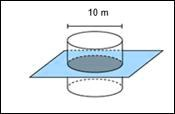
The correct answer is that 10 m represents the diameter of the cylinder.
Explanation
The image displays a three dimensional geometric shape known as a cylinder, which is intersected by a horizontal plane. The label “10 m” is accompanied by a double headed arrow that spans the widest part of the cylinder’s circular top. This measurement is the diameter of the cylinder.
In geometry, the diameter is a straight line segment that passes through the center of a circle and has its endpoints on the circle’s edge, also known as the circumference. It is the longest possible chord of a circle. The “m” in “10 m” stands for meters, which is a unit of length in the metric system, indicating the physical size of the cylinder.
Knowing the diameter is fundamental for calculating other important properties of the cylinder. For instance, the radius (r), which is the distance from the center of the circle to any point on its circumference, is always half of the diameter. In this case, the radius would be 10 m / 2 = 5 m.
With the radius, we can determine the area of the cylinder’s circular base using the formula A = πr². For this cylinder, the base area would be π * (5 m)² = 25π square meters. We could also calculate the circumference, which is the distance around the circular base, using the formula C = πd, resulting in a circumference of 10π meters.
To calculate the cylinder’s volume (V = πr²h) or its total surface area (A = 2πrh + 2πr²), we would also need its height (h), which is not provided in the diagram. However, the diameter is the essential first piece of information required for any of these subsequent calculations. Therefore, the 10 m label specifies a key dimension of the cylinder, its diameter.