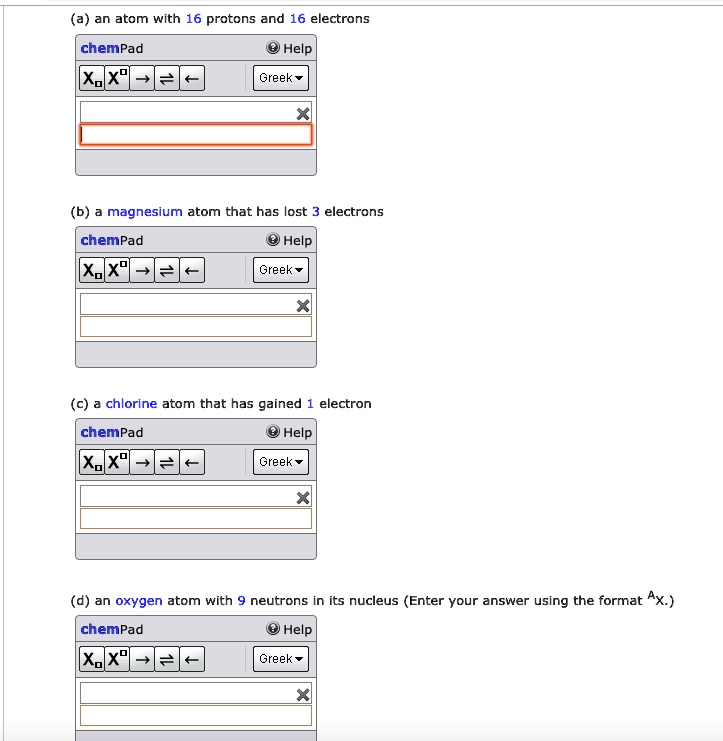
An atom with 16 protons and 16 electrons. (b) A magnesium atom that has lost 3 electrons. (c) A chlorine atom that has gained an electron. (d) An oxygen atom with neutrons in its nucleus (Enter your answer using the format Ax:).
The Correct Answer and Explanation is:
ere are the correct answers for each part:
(a) S
(b) Mg³⁺
(c) Cl⁻
(d) ¹⁷O
Explanation
To determine the correct chemical symbol for an atom or ion, we need to understand the roles of its subatomic particles: protons, neutrons, and electrons.
- Protons (p⁺): The number of protons defines the element’s atomic number (Z) and its identity. For example, any atom with 16 protons is sulfur.
- Electrons (e⁻): The number of electrons determines the overall electrical charge. In a neutral atom, the number of electrons equals the number of protons. If an atom gains electrons, it becomes a negatively charged ion (anion). If it loses electrons, it becomes a positively charged ion (cation). The charge is calculated as (number of protons) – (number of electrons).
- Neutrons (n⁰): The number of neutrons, along with the protons, determines the atom’s mass number (A). The mass number is the sum of protons and neutrons (A = p⁺ + n⁰). Atoms of the same element with different numbers of neutrons are called isotopes.
Here is a breakdown of each part of the question:
(a) An atom with 16 protons and 16 electrons.
The atomic number is 16, which corresponds to the element Sulfur (S) on the periodic table. Since the number of protons (16) equals the number of electrons (16), the net charge is 16 – 16 = 0. Therefore, this is a neutral sulfur atom, represented by the symbol S.
(b) A magnesium atom that has lost 3 electrons.
Magnesium (Mg) has an atomic number of 12, meaning it has 12 protons. A neutral magnesium atom also has 12 electrons. When it loses 3 electrons, it has 12 – 3 = 9 electrons remaining. The charge becomes (12 protons) – (9 electrons) = +3. This positively charged ion is written as Mg³⁺.
(c) A chlorine atom that has gained 1 electron.
Chlorine (Cl) has an atomic number of 17, so it has 17 protons. A neutral chlorine atom has 17 electrons. When it gains 1 electron, it has 17 + 1 = 18 electrons. The charge becomes (17 protons) – (18 electrons) = -1. This negatively charged ion is written as Cl⁻. By convention, the “1” is omitted from the charge.
(d) An oxygen atom with 9 neutrons in its nucleus.
Oxygen (O) has an atomic number of 8, which means it contains 8 protons. The problem specifies that this atom has 9 neutrons. The mass number (A) is the sum of protons and neutrons: A = 8 + 9 = 17. The requested format is ᴬX, where A is the mass number and X is the element symbol. Thus, the correct notation for this isotope of oxygen is ¹⁷O.