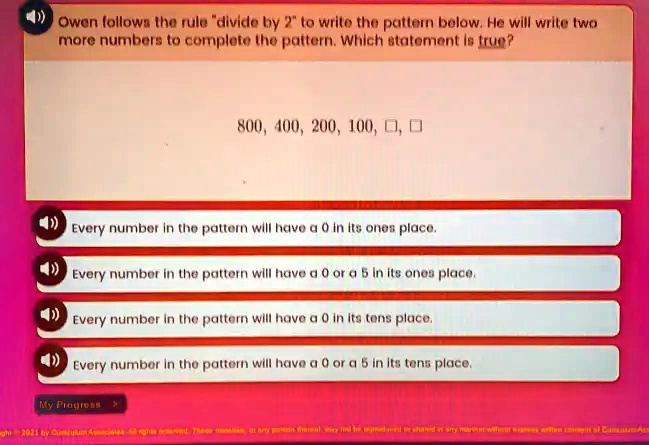
Owen follows the rule “divide by 2” to write the pattern below. He will write two more numbers to complete the pattern. Which statement is true? 800, 400, 200, 100, , Every number in the pattern will have a 0 in its ones place. Every number in the pattern will have a 0 or a 5 in its ones place. Every number in the pattern will have a 0 in its tens place. Every number in the pattern will have a 0 or a 5 in its tens place.
The Correct Answer and Explanation is:
The correct answer is: Every number in the pattern will have a 0 or a 5 in its ones place.
Here is a step-by-step explanation:
The problem asks us to complete a number pattern and then determine which of the given statements about the pattern is true. The rule for the pattern is “divide by 2”.
First, let’s find the two missing numbers. The pattern starts with 800, 400, 200, 100.
To find the next number, we take the last number, 100, and apply the rule:
100 ÷ 2 = 50
Now, to find the second missing number, we take our new last number, 50, and apply the rule again:
50 ÷ 2 = 25
So, the complete pattern is: 800, 400, 200, 100, 50, 25.
Next, we must evaluate each statement using this complete pattern.
Statement 1: Every number in the pattern will have a 0 in its ones place.
Let’s check the ones place for each number:
800, 400, 200, 100, 50, 25
The number 25 has a 5 in its ones place, not a 0. Therefore, this statement is false.
Statement 2: Every number in the pattern will have a 0 or a 5 in its ones place.
Let’s check the ones place again:
800 (ends in 0)
400 (ends in 0)
200 (ends in 0)
100 (ends in 0)
50 (ends in 0)
25 (ends in 5)
All the numbers in the pattern end in either a 0 or a 5. This statement is true.
Statement 3: Every number in the pattern will have a 0 in its tens place.
Let’s check the tens place for each number:
800, 400, 200, 100, 50, 25
The number 50 has a 5 in its tens place, and the number 25 has a 2 in its tens place. Since not all numbers have a 0 in the tens place, this statement is false.
Statement 4: Every number in the pattern will have a 0 or a 5 in its tens place.
Let’s check the tens place again:
800, 400, 200, 100, 50, 25
The number 25 has a 2 in its tens place, which is not a 0 or a 5. Therefore, this statement is false.
The only statement that is true for every number in the completed pattern is the second one.