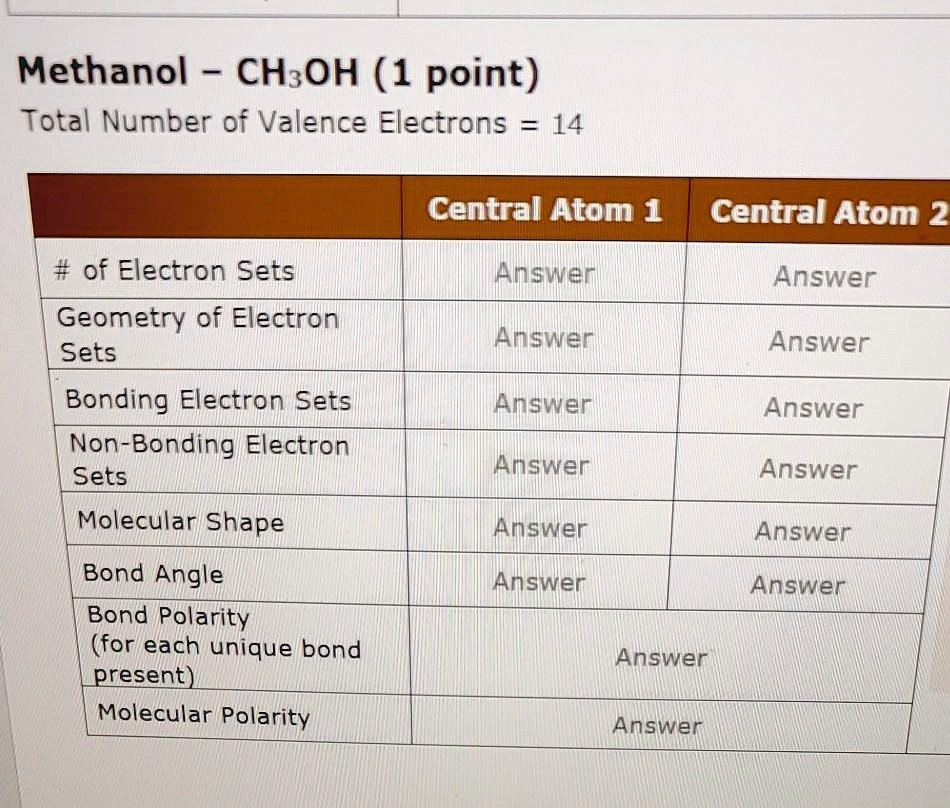
Methanol CH;OH (1 point) Total Number of Valence Electrons 14 Central Atom 1 Central Atom 2 of Electron Sets Geometry of Electron Sets Bonding Electron Sets Non- Bonding Electron Sets Molecular Shape Bond Angle Bond Polarity (for each unique bond present) Molecular Polarity answen Answer Answer Answer Answer Answer Answer Answer Answer Answer Answer Answer Answer Answer
Methanol CH;OH (1 point) Total Number of Valence Electrons 14 Central Atom 1 Central Atom 2 of Electron Sets Geometry of Electron Sets Bonding Electron Sets Non- Bonding Electron Sets Molecular Shape Bond Angle Bond Polarity (for each unique bond present) Molecular Polarity answen Answer Answer Answer Answer Answer Answer Answer Answer Answer Answer Answer Answer Answe
The Correct Answer and Explanation is:
Here are the correct answers for the analysis of methanol (CH₃OH).
| Central Atom 1 (Carbon) | Central Atom 2 (Oxygen) | |
| # of Electron Sets | 4 | 4 |
| Geometry of Electron Sets | Tetrahedral | Tetrahedral |
| Bonding Electron Sets | 4 | 2 |
| Non-Bonding Electron Sets | 0 | 2 |
| Molecular Shape | Tetrahedral | Bent |
| Bond Angle | approx. 109.5° | < 109.5° (approx. 104.5°) |
| Bond Polarity (for each unique bond present) | C-H: Nonpolar/Slightly Polar, C-O: Polar, O-H: Polar | |
| Molecular Polarity | Polar |
Explanation
To determine the molecular properties of methanol (CH₃OH), we first draw its Lewis structure. With a total of 14 valence electrons (4 from carbon, 6 from oxygen, and 1 from each of the four hydrogens), the structure shows a central carbon atom bonded to three hydrogen atoms and one oxygen atom. This oxygen atom is then bonded to the fourth hydrogen atom. The oxygen atom also holds two non-bonding lone pairs of electrons to complete its octet. This structure reveals two central atoms: carbon and oxygen.
Analysis of Carbon (Central Atom 1):
The carbon atom is surrounded by four electron sets, all of which are bonding pairs (three C-H bonds and one C-O bond). According to VSEPR theory, four electron domains arrange themselves in a tetrahedral geometry to minimize repulsion. Since there are no lone pairs on the carbon, both the electron geometry and the molecular shape around the carbon atom are tetrahedral. The bond angles (H-C-H and H-C-O) are approximately the ideal tetrahedral angle of 109.5 degrees.
Analysis of Oxygen (Central Atom 2):
The oxygen atom is also surrounded by four electron sets: two are bonding pairs (one C-O bond, one O-H bond) and two are non-bonding lone pairs. The electron geometry for these four sets is also tetrahedral. However, because only two of these sets are bonds, the molecular shape around the oxygen is described as bent. The two lone pairs exert a stronger repulsive force than bonding pairs, compressing the C-O-H bond angle to be less than 109.5 degrees, typically around 104.5 degrees, similar to water.
Polarity:
Bond polarity is determined by the difference in electronegativity. The C-H bond is considered nonpolar. The C-O and O-H bonds are both polar covalent because oxygen is significantly more electronegative than carbon and hydrogen. The overall molecule is polar. This is because the asymmetrical arrangement of these polar bonds and the bent shape around the oxygen atom create an uneven distribution of electron density. The bond dipoles do not cancel each other out, resulting in a net molecular dipole for methanol.