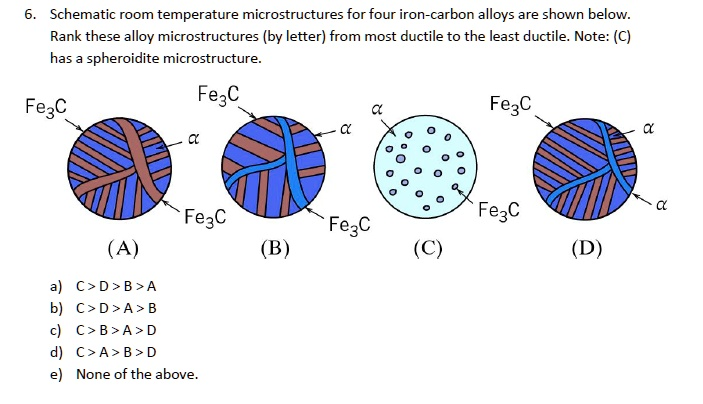
Schematic room temperature microstructures for four iron-carbon alloys are shown below. Rank these alloy microstructures (by letter) from most ductile to the least ductile. Note: (C) has a spheroidite microstructure. Fe3C Fe3C ? Fe3C ? ? ? Fe3C (B) (A) a) C>D>B>A b) C>D>A> B c) C>B>A>D d) C>A>B>D e) None of the above. Fe3C Fe3C ? (C) (D)
The Correct Answer and Explanation is:
The correct answer is c) C > B > A > D.
Explanation
This question asks to rank different iron-carbon microstructures from most ductile to least ductile. Ductility in these alloys is primarily determined by the morphology and distribution of the hard, brittle cementite phase (Fe3C) within the soft, ductile ferrite (α) matrix. A microstructure that allows for easier dislocation movement within the ferrite will be more ductile.
- Spheroidite (C): This microstructure, as noted in the problem, consists of small, spherical particles of cementite dispersed in a continuous ferrite matrix. The spherical shape of the hard cementite particles presents the minimum possible phase boundary area for a given volume fraction. This minimizes the obstruction to dislocation motion through the continuous, soft ferrite matrix. As a result, spheroidite is the softest, weakest, and most ductile of the microstructures shown.
- Pearlite (A, B, and D): These three microstructures are all forms of pearlite, which consists of alternating lamellae (layers) of ferrite and cementite. The key difference between them is the interlamellar spacing, or the thickness of the layers. Ductility in pearlite decreases as the layers become thinner and the number of phase boundaries increases.
- Coarse Pearlite (B): This structure has the thickest layers of both ferrite and cementite. The relatively thick, continuous ferrite layers allow for more significant dislocation movement before encountering a hard cementite boundary. This makes coarse pearlite the most ductile among the pearlite structures.
- Medium Pearlite (A): This structure has an interlamellar spacing that is intermediate between coarse and fine pearlite. Its ductility is therefore lower than coarse pearlite but higher than fine pearlite.
- Fine Pearlite (D): This structure has very thin, closely packed lamellae. The high density of ferrite-cementite phase boundaries acts as a very effective barrier to dislocation movement, making the material significantly stronger, harder, and consequently, the least ductile of all the options.
Therefore, the correct ranking from most ductile to least ductile is: Spheroidite > Coarse Pearlite > Medium Pearlite > Fine Pearlite, which corresponds to the sequence C > B > A > D.