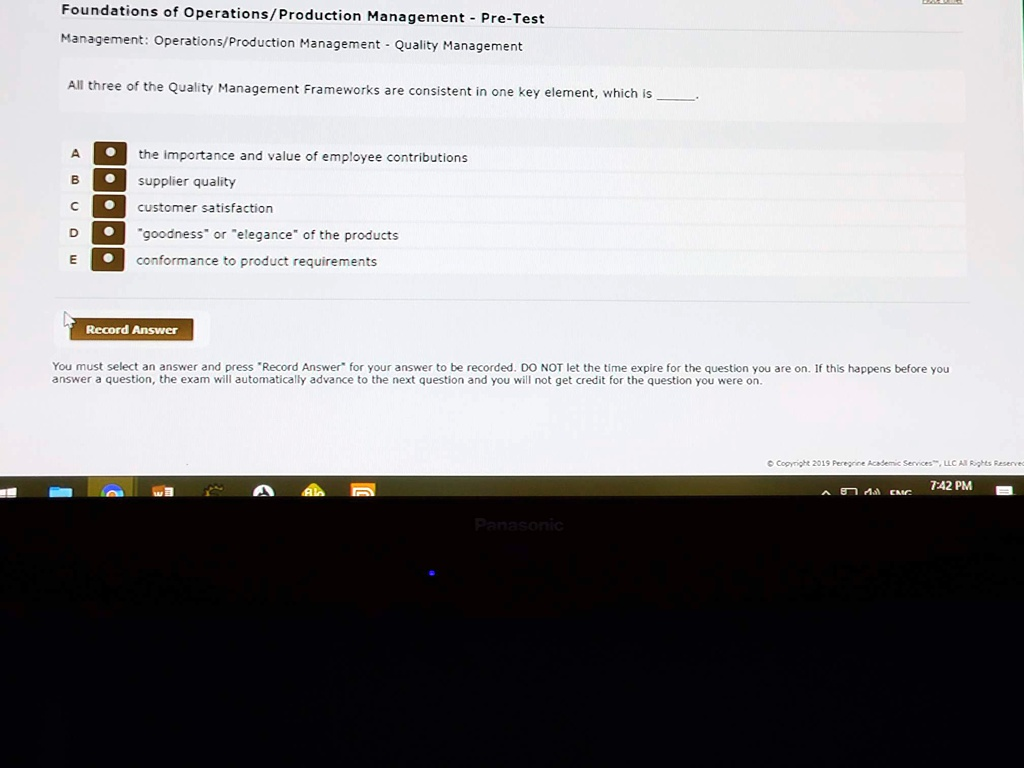
BMAL 590 Operations Production Foundations of Operations/Production Management Pre-Test Management: Operations Production Management Quality Management All three of the Quality Management Frameworks are consistent in one key element, which is the importance and value of employee contributions, supplier quality, customer satisfaction, goodness, and elegance of the products’ conformance to product requirements. Record Answer You must select an answer and press “Record Answer” for your answer to be recorded. DO NOT let the time expire for the question. You are answering the question; the exam will automatically advance to the next question, and you will not get credit for the question you were answering if this happens before you. Ccd 0lS{8t Eete Laco WaF = Lat TA2PM 031 Aa Elte
The Correct Answer and Explanation is:
The correct answer is C. customer satisfaction.
All major Quality Management Frameworks, despite their different methodologies and tools, are fundamentally united by the core principle of customer satisfaction. This concept serves as the ultimate goal and the primary driver for all quality-related activities. The three most prominent frameworks—Total Quality Management (TQM), Six Sigma, and ISO 9001—all place the customer at the center of their philosophy.
Total Quality Management (TQM) is a management philosophy that seeks long-term success through customer satisfaction. TQM posits that every employee and every process in an organization must be dedicated to delivering value to the customer. Quality pioneers like W. Edwards Deming and Joseph M. Juran emphasized that quality is not just about internal metrics but about meeting and exceeding customer needs and expectations, defining it as “fitness for use.”
Six Sigma is a data-driven methodology focused on eliminating defects and process variation. A cornerstone of any Six Sigma project is capturing the “Voice of the Customer” (VOC). The VOC is used to define what constitutes a defect and to set the critical-to-quality (CTQ) characteristics for a product or service. Therefore, the entire effort of reducing defects to a level of 3.4 per million opportunities is directly aimed at improving the customer experience and increasing satisfaction.
ISO 9001 is an international standard for a quality management system (QMS). The very first of its seven quality management principles is “Customer Focus.” The standard requires organizations to understand current and future customer needs, meet customer requirements, and strive to exceed customer expectations. All other principles and requirements within ISO 9001, such as leadership, process approach, and improvement, are designed to support this primary objective.
While elements like employee contributions (A) and conformance to requirements (E) are crucial, they are means to an end. An organization empowers employees and conforms to specifications precisely in order to achieve the ultimate goal: a satisfied customer.