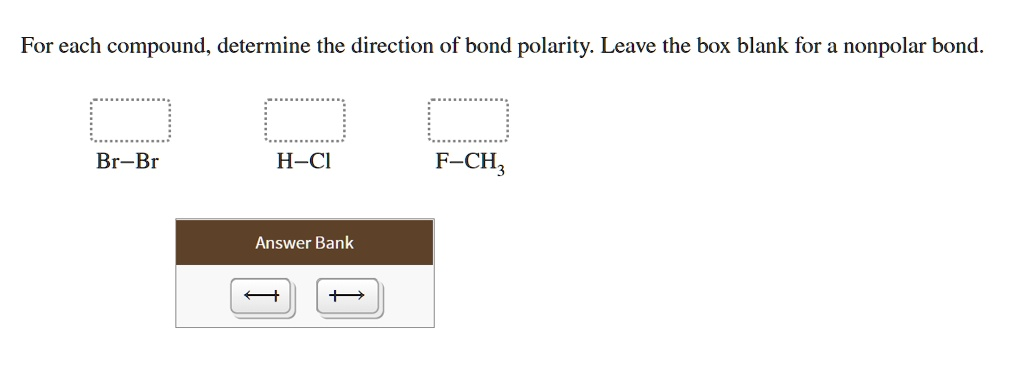
For each compound, determine the direction of bond polarity: Leave the box blank for nonpolar bond: Br-Br H-CL F-CH3 Answer Bank
The Correct Answer and Explanation is:
Let’s break down each compound:
- Br-Br: This is a bond between two bromine atoms. Since both atoms are the same, they have the same electronegativity. When the electronegativity difference is zero, the electrons are shared equally. This results in a nonpolar bond. Therefore, the box should be left blank.
- H-Cl: This is a bond between hydrogen (H) and chlorine (Cl). Chlorine is more electronegative than hydrogen, so the electrons in the bond are pulled more towards chlorine. This results in a polar bond with the dipole pointing towards chlorine (Cl), which is the more electronegative element. The direction of polarity should be marked with an arrow pointing towards Cl.
- F-CH3: This is a bond between fluorine (F) and a methyl group (CH3). Fluorine is highly electronegative compared to carbon and hydrogen in the CH3 group, so the electron density is pulled towards fluorine. This results in a polar bond with the dipole pointing towards fluorine (F). The direction of polarity should be marked with an arrow pointing towards F.
So, in summary:
- Br-Br: nonpolar, leave the box blank.
- H-Cl: polar, arrow pointing towards Cl.
- F-CH3: polar, arrow pointing towards F.
This analysis is based on the electronegativity differences between the atoms involved in the bonds.