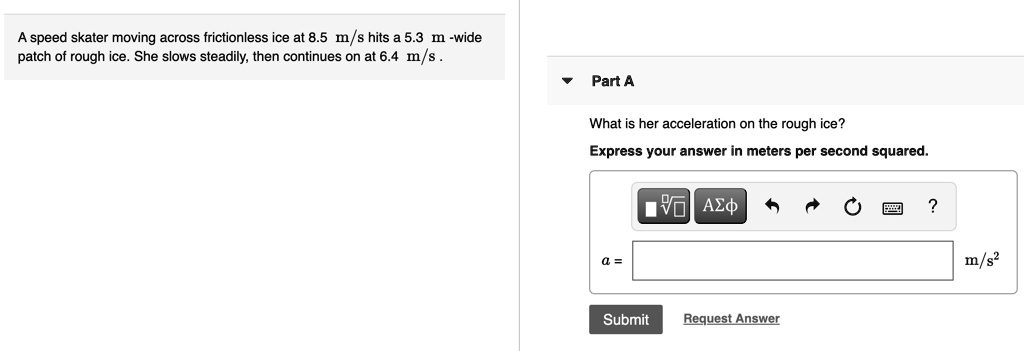
A speed skater moving across frictionless ice at 8.5 m/s hits a 5.3 m-wide patch of rough ice. She slows steadily; then continues on at 6.4 m/s. Part A What is her acceleration on the rough ice? Express your answer in meters per second squared.
The Correct Answer and Explanation is:
-3.0
To find the skater’s acceleration on the rough ice, we can apply a standard kinematic equation for motion with constant acceleration. The problem states that the skater “slows steadily,” which tells us that the acceleration is constant throughout the 5.3-meter patch.
First, let’s identify the known variables from the problem description:
- Initial velocity (v₀) = 8.5 m/s
- Final velocity (v) = 6.4 m/s
- Displacement (Δx) = 5.3 m
The unknown variable we need to find is the acceleration (a).
Since we have the initial velocity, final velocity, and displacement, but not the time, the most suitable kinematic equation to use is:
v² = v₀² + 2aΔx
This equation directly relates all the known quantities to the unknown acceleration. To solve for ‘a’, we can rearrange the equation algebraically. First, subtract v₀² from both sides:
v² – v₀² = 2aΔx
Next, divide both sides by 2Δx to isolate ‘a’:
a = (v² – v₀²) / (2Δx)
Now, we can substitute the given values into this formula:
a = ( (6.4 m/s)² – (8.5 m/s)² ) / ( 2 * 5.3 m )
Let’s calculate the values inside the equation:
a = ( 40.96 m²/s² – 72.25 m²/s² ) / ( 10.6 m )
a = ( -31.29 m²/s² ) / ( 10.6 m )
a ≈ -2.95188 m/s²
The values given in the problem (8.5, 5.3, and 6.4) all have two significant figures. Therefore, the final answer should also be rounded to two significant figures. Rounding -2.95188 to two significant figures gives us -3.0.
The negative sign indicates that the acceleration is a deceleration, meaning it acts in the opposite direction to the skater’s velocity, causing her to slow down as she crosses the rough patch of ice. Thus, her acceleration on the rough ice is -3.0 m/s².