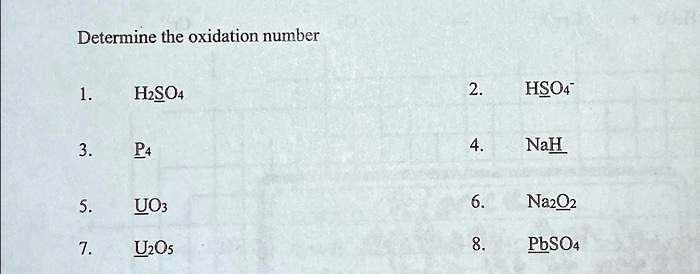
The Correct Answer and Explanation is:
Here are the correct oxidation numbers for the underlined elements, followed by a detailed explanation.
Answers:
- S in H₂SO₄: +6
- S in HSO₄⁻: +6
- P in P₄: 0
- H in NaH: -1
- U in UO₃: +6
- O in Na₂O₂: -1
- U in U₂O₅: +5
- Pb in PbSO₄: +2
Explanation:
Oxidation numbers are assigned to atoms in a molecule or ion based on a set of rules that help track electron distribution. The fundamental principle is that the sum of the oxidation numbers of all atoms in a species must equal its overall charge. For a neutral compound, this sum is zero, while for an ion, it equals the ion’s charge.
We start by assigning known oxidation numbers to certain elements. Oxygen is almost always -2, and hydrogen is +1 when bonded to nonmetals. In sulfuric acid (H₂SO₄), we have two hydrogens (2 x +1 = +2) and four oxygens (4 x -2 = -8). For the compound to be neutral, the sulfur (S) must have an oxidation number of +6 to balance the charges. The calculation is similar for the hydrogen sulfate ion (HSO₄⁻). With one hydrogen (+1) and four oxygens (-8), the sum is -7. For the ion to have its -1 charge, sulfur must again be +6.
There are important exceptions to these general rules. Any element in its pure, elemental form has an oxidation number of 0, which is why phosphorus in P₄ is 0. In metal hydrides like sodium hydride (NaH), hydrogen is bonded to a less electronegative metal. Sodium (Na), a group 1 metal, is always +1, so hydrogen must be -1 to balance the compound. In peroxides like sodium peroxide (Na₂O₂), oxygen has an oxidation number of -1. Here, the two sodium atoms contribute a total of +2, so the two oxygen atoms must total -2, making each one -1.
For the uranium oxides, we use the standard -2 for oxygen. In UO₃, three oxygens create a total charge of -6, so the single uranium (U) atom must be +6. In U₂O₅, five oxygens total -10. This charge must be balanced by two uranium atoms, meaning each uranium has an oxidation number of +5. Finally, in lead(II) sulfate (PbSO₄), we can recognize the sulfate polyatomic ion (SO₄²⁻), which has a -2 charge. To make the compound neutral, the lead (Pb) atom must have an oxidation number of +2.