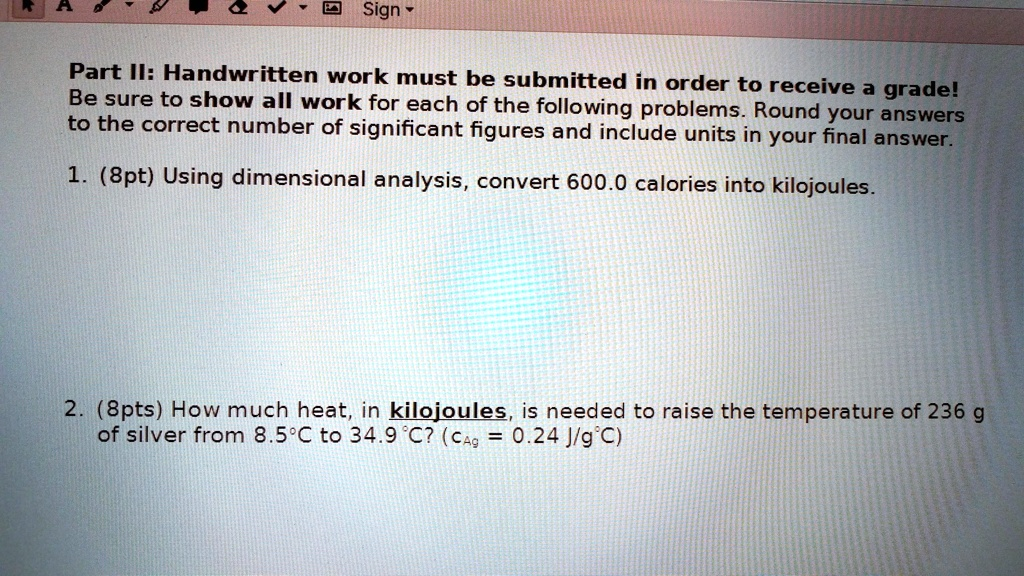
Handwritten work must be submitted in order to receive a grade! Be sure to show all work for each of the following problems
The Correct Answer and Explanation is:
Here are the correct answers and the explanation for the problems shown in the image.
Correct Answers:
- 2.510 kJ
- 1.5 kJ
Explanation
The solutions to these problems involve unit conversion, applying the specific heat formula, and adhering to the rules for significant figures.
1. Converting Calories to Kilojoules
To solve the first problem, you must convert 600.0 calories into kilojoules using dimensional analysis. This process involves two main conversion factors. First, you convert calories (cal) to joules (J) using the standard relationship: 1 calorie = 4.184 joules. Second, you convert joules to kilojoules (kJ) using the metric prefix definition: 1 kilojoule = 1000 joules.
The calculation is set up as follows:
600.0 cal × (4.184 J / 1 cal) × (1 kJ / 1000 J) = 2.5104 kJ
The initial measurement, 600.0 calories, has four significant figures. The conversion factor 4.184 J/cal also has four significant figures. According to the rules of multiplication, the final answer should be rounded to the least number of significant figures, which is four. Therefore, 2.5104 kJ is rounded to 2.510 kJ.
2. Calculating Heat Transfer
The second problem requires calculating the amount of heat needed to raise the temperature of a substance. This is done using the specific heat capacity formula: q = mcΔT. In this formula, ‘q’ represents the heat energy, ‘m’ is the mass, ‘c’ is the specific heat capacity, and ‘ΔT’ is the change in temperature.
First, identify the given values:
- Mass (m) = 236 g
- Specific heat of silver (c) = 0.24 J/g°C
- Initial temperature = 8.5°C
- Final temperature = 34.9°C
Next, calculate the temperature change (ΔT):
ΔT = T_final – T_initial = 34.9°C – 8.5°C = 26.4°C
Now, substitute the values into the formula to find the heat in joules:
q = (236 g) × (0.24 J/g°C) × (26.4°C) = 1496.064 J
The value with the fewest significant figures is the specific heat (0.24), which has two. The final answer must be rounded to two significant figures, which makes the result 1500 J. Finally, convert this to kilojoules as requested:
1500 J × (1 kJ / 1000 J) = 1.5 kJ.