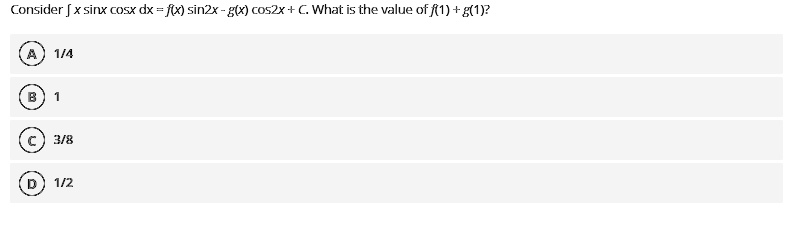
The Correct Answer and Explanation is:
Correct Answer: C
Explanation:
The problem asks for the value of f(1) + g(1) given the integral equation:
∫ x sinx cosx dx = f(x) sin2x – g(x) cos2x + C
To find the functions f(x) and g(x), we first need to solve the integral on the left side.
- Simplify the Integrand:
We can simplify the term sinx cosx using the double-angle identity for sine, which is sin(2x) = 2sinx cosx. Rearranging this, we get sinx cosx = (1/2)sin(2x).
Substituting this into the integral gives:
∫ x * (1/2)sin(2x) dx = (1/2) ∫ x sin(2x) dx - Integration by Parts:
Now, we can solve the integral ∫ x sin(2x) dx using integration by parts. The formula is ∫ u dv = uv – ∫ v du.
Let’s choose:- u = x (so du = dx)
- dv = sin(2x) dx (so v = ∫ sin(2x) dx = – (1/2)cos(2x))
∫ x sin(2x) dx = x * (-1/2)cos(2x) – ∫ (-1/2)cos(2x) dx
∫ x sin(2x) dx = – (x/2)cos(2x) + (1/2) ∫ cos(2x) dx
∫ x sin(2x) dx = – (x/2)cos(2x) + (1/2) * (1/2)sin(2x) + C’
∫ x sin(2x) dx = (1/4)sin(2x) – (x/2)cos(2x) + C’ - Complete the Original Integral:
Now substitute this result back into our expression from step 1:
(1/2) ∫ x sin(2x) dx = (1/2) [ (1/4)sin(2x) – (x/2)cos(2x) + C’ ]
∫ x sinx cosx dx = (1/8)sin(2x) – (x/4)cos(2x) + C (where C = C’/2) - Identify f(x) and g(x):
We are given that ∫ x sinx cosx dx = f(x) sin2x – g(x) cos2x + C.
Comparing this with our result:
f(x) sin2x – g(x) cos2x + C = (1/8)sin(2x) – (x/4)cos(2x) + CBy matching the coefficients of the trigonometric functions, we find:- f(x) = 1/8
- g(x) = x/4
- Calculate f(1) + g(1):
Now we can evaluate the functions at x = 1:- f(1) = 1/8
- g(1) = 1/4
f(1) + g(1) = 1/8 + 1/4 = 1/8 + 2/8 = 3/8
Therefore, the value of f(1) + g(1) is 3/8.