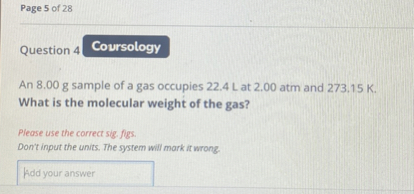
Coursology An 8.00 g sample of a gas occupies 22.4 L at 2.00 atm and 273.15 K
The Correct Answer and Explanation is:
4.00
To determine the molecular weight of the gas, we can use the Ideal Gas Law equation, which relates pressure, volume, temperature, and the number of moles of a gas. The formula is:
PV = nRT
Here, P is the pressure, V is the volume, n is the number of moles, R is the ideal gas constant, and T is the temperature in Kelvin.
The question asks for the molecular weight (M), which is defined as the mass (m) of a substance divided by the number of moles (n).
M = m / n
First, we need to solve the Ideal Gas Law for the number of moles (n):
n = PV / RT
Next, we can substitute this expression for n into the molecular weight formula:
M = m / (PV / RT) which rearranges to M = (mRT) / (PV)
Now, we can plug in the given values from the problem:
- mass (m) = 8.00 g
- Pressure (P) = 2.00 atm
- Volume (V) = 22.4 L
- Temperature (T) = 273.15 K
The value of the ideal gas constant (R) that matches these units (L, atm, K, mol) is 0.08206 L·atm/(mol·K).
Let’s calculate the molecular weight:
M = (8.00 g * 0.08206 L·atm/(mol·K) * 273.15 K) / (2.00 atm * 22.4 L)
M = (179.37 g·L·atm/mol) / (44.8 L·atm)
M ≈ 4.0038 g/mol
The final step is to apply the rules for significant figures. The given values for mass (8.00 g), pressure (2.00 atm), and volume (22.4 L) each have three significant figures. Since the calculation involves multiplication and division, the result should be rounded to the lowest number of significant figures, which is three.
Rounding 4.0038 to three significant figures gives us 4.00.