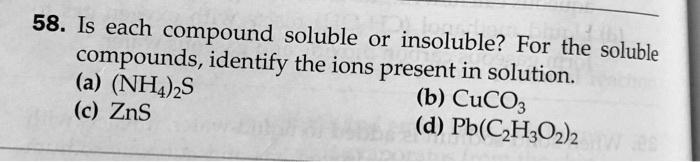
The Correct Answer and Explanation is:
Here is the determination of solubility for each compound and the identification of ions for the soluble ones.
- (a) (NH₄)₂S: Soluble. Ions present are NH₄⁺ and S²⁻.
- (b) CuCO₃: Insoluble.
- (c) ZnS: Insoluble.
- (d) Pb(C₂H₃O₂)₂: Soluble. Ions present are Pb²⁺ and C₂H₃O₂⁻.
To determine if an ionic compound is soluble or insoluble in water, we use a set of established solubility rules. These guidelines help predict whether a compound will dissolve to form a homogeneous solution or remain as a solid precipitate. For compounds that do dissolve, they dissociate into their constituent cations and anions, which move freely within the solution.
The first compound, (a) ammonium sulfide, (NH₄)₂S, is soluble. A primary solubility rule states that all common compounds containing the ammonium ion (NH₄⁺) are soluble in water, with no significant exceptions. While most sulfide (S²⁻) compounds are insoluble, the rule for the ammonium ion takes precedence. When ammonium sulfide dissolves, it separates into its ions. The chemical formula indicates that for each unit of (NH₄)₂S, there are two ammonium ions and one sulfide ion. Therefore, the ions present in the solution are the ammonium cation (NH₄⁺) and the sulfide anion (S²⁻).
Next, (b) copper(II) carbonate, CuCO₃, is insoluble. The general rule for carbonates (CO₃²⁻) is that they are insoluble in water. The only common exceptions are carbonates of Group 1 elements (like sodium and potassium) and the ammonium ion. Since copper (Cu²⁺) is a transition metal and not one of these exceptions, copper(II) carbonate does not dissolve in water.
Similarly, (c) zinc sulfide, ZnS, is insoluble. Most compounds containing the sulfide ion (S²⁻) are insoluble. The main exceptions are sulfides of Group 1 cations and the ammonium ion. Zinc (Zn²⁺) does not fall into this category of exceptions, so ZnS is classified as an insoluble compound and will form a solid in water.
Finally, (d) lead(II) acetate, Pb(C₂H₃O₂)₂, is soluble. A very reliable solubility rule is that all common acetates (C₂H₃O₂⁻) are soluble in water. While many lead compounds are known to be insoluble, lead(II) acetate is a prominent exception to this pattern. When it dissolves, it dissociates completely. The formula shows that one unit of lead(II) acetate yields one lead(II) cation (Pb²⁺) and two acetate anions (C₂H₃O₂⁻) in solution.