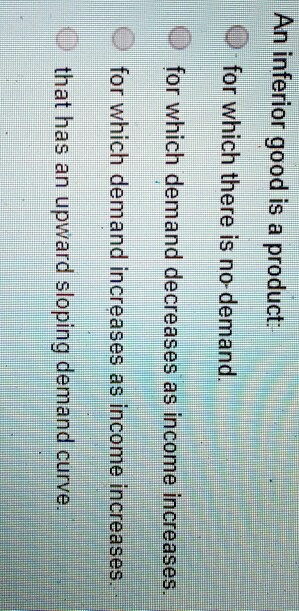
An inferior good is a product: for which there is no-demand. for which demand decreases as income increases. for which demand increases as income increases. that has an upward sloping demand curve.
The Correct Answer and Explanation is:
The correct answer is: for which demand decreases as income increases.
Explanation
In economics, the classification of goods as “inferior” or “normal” is based on how consumer demand for them changes in response to a change in consumer income. An inferior good is defined as a product for which there is an inverse relationship between income and demand. This means that as consumers’ disposable income rises, they buy less of the good, and conversely, as their income falls, they buy more of it.
This behavior occurs because consumers with higher incomes can afford more desirable, higher-quality, or more expensive substitutes. They switch their spending away from the inferior good towards these “normal goods.” For example, a person with a low income might rely on public transportation. If their income increases significantly, they might choose to buy a car for greater convenience, thereby decreasing their demand for bus or subway tickets. In this scenario, public transportation acts as an inferior good. Other common examples include generic store-brand products, used clothing, and instant noodles. When income is tight, demand for these items is higher, but as income grows, consumers often upgrade to brand-name goods, new clothes, and more elaborate meals.
It is crucial not to confuse an inferior good with a Giffen good. A Giffen good is a very rare type of inferior good that violates the law of demand, meaning it has an upward-sloping demand curve (demand increases as price increases). However, the defining characteristic of all inferior goods, including the vast majority that have standard downward-sloping demand curves, is simply that demand for them falls as consumer income rises